Filming Same-Sex: Queer Film Subcultures and the Disruption of Surveillance in Nigeria
by
Chimee Adịọha
It is Saturday morning on my second visit to Northern California and I am watching the Boys Like Us series on Youtube. The series has become one of the best things I watched in 2025. Directed by Abiodun Udom, it is a fast-paced series about four young friends living together in a Lagos duplex, navigating social pressures, with experiences that are both queer and Nigerian. The series, on its second week of being published, gained over 100,000 views and sparked praises on social media platforms. As much as I was impressed with the crafting, drafting, and styling for this series, I would also count it as one of those visuals that stood as a clear and straightforward object of confrontation towards Nigeria’s anti queer rhetoric, a distinct disruption of visual surveillance. The passing of the Same-Sex Marriage Prohibition Act (SSMPA) in Nigeria did not affect only the instances laid out in the provisions of the legal document, but it has influenced arts and entertainment industries such as the Nigeria’s film industry, especially in facilitating the poor, biased, discriminatory representation of queer lives. In what I like to refer to as visual phobia, the SSMPA plays a role in constructing a climate of fear towards queer related film production and viewership. But series like Boys Like Us (2025) have afforded us the opportunity to look beyond those draconian bonds and gaze into a possibility that is both visually confrontational and emotionally deserving.
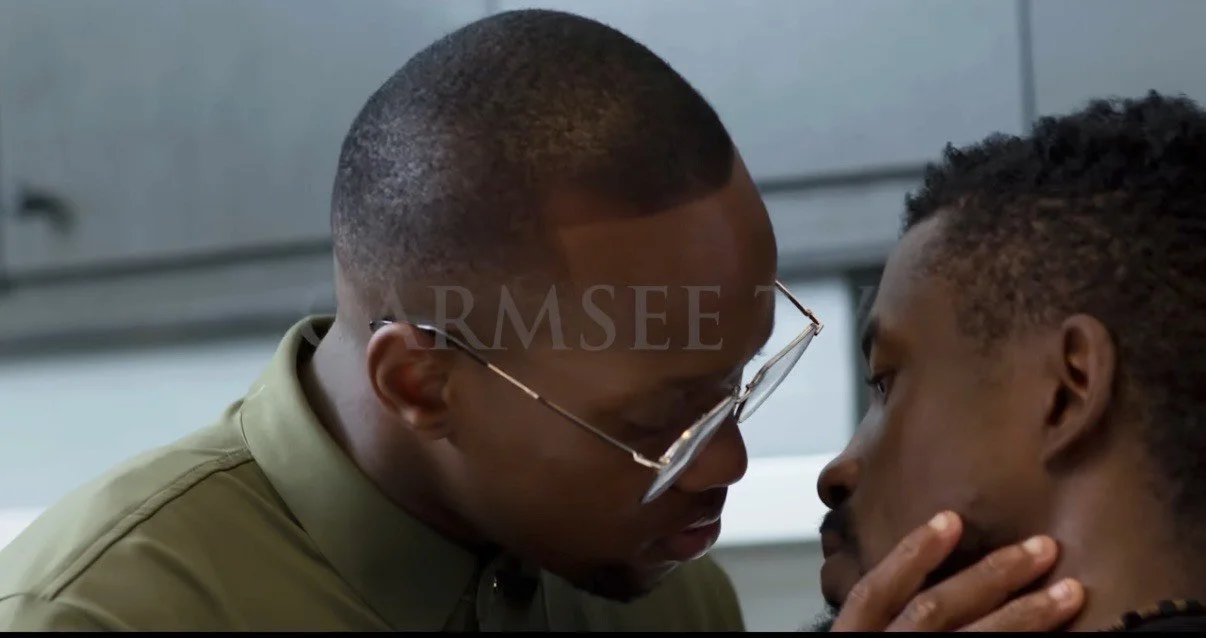
Still from Boys Like Us
What I try to achieve with this essay is to highlight the background of queer film censorships in Nigeria and use three categories that exist so far in the Nigerian film industry to articulate my ideas on the need to expand dissemination strategies for various forms of queer filmmaking. While I use these three categories (The Nollywood, The Not-for-Profit, The Upcoming) to showcase three different films, Hell or High Water (2016) , Complicated (2024), Beyond the Closet (2024)- I also draw backgrounds from Lindsey B. Green-Simms, Evelynn Hammonds, Jennifer DeClue, Michelle Parkerson and Cathy J. Cohen. Through these scholars, I aim to make a sense of the different realities that help characterize Nigerian queer filmmaking. Their views towards the blending of sexuality and race provides a balance to how we can investigate queer filmography globally as well as serves as a generous conduit in defining the possibilities and the future of Nigerian queer cinema.
Centering Sexuality
Kehinde Okanlawon’s essay “Cultures of Public Intervention Regarding LGBTQ Issues after Nigeria’s Same-Sex Marriage Prohibition (SSMPA)” investigates the consequences of the SSMPA, such as the increase and validation of anti-queer hatred and violence:
“The introduction of SSMPA was a blow to the hopes and objectives of Nigerian LGBTQ groups; it transformed the political and social landscape by fomenting heated public anti-LGBTQ vitriol and creating an atmosphere in which otherwise ‘normal’ citizens felt that they were working for the national good in acting upon homophobic sentiments” (Okanlawon 641).
The harsh provisions of the law included sections such as: marriages are only marriages if they are contracted between a man and a woman; same sex marriages are prohibited; the registration of gay clubs, organizations, associations, and meetings are prohibited. In addition to this overall criminalization, the law also attaches penalties of up to 14 years imprisonment for these offences. But as ignorant as Nigeria’s homophobic public has virally become since passing the law in 2014, the SSMPA’s major hit was to criminalize same sex marriage and public display of affection, and not the act of identifying as an LGBTQ+ person. Regardless of the law’s major focus on same-sex marriage, the presence of both state and non-state sanctioned violence doubled and became notorious. There seemed to be a “take over” by the general public that empowered homophobia, mostly emboldened by the misreading of the 2014 Act.
In 2024, a 9th August BBC report announced the death of Area Mama, a popular Nigerian Tiktoker. She was found dead on a highway in the capital city of Abuja. On October 27th 2025, the Citizen section of Nigeria’s Zikoko Magazine reported the death of Hilary, thrown down from a two-storey building that emanated from an alleged homophobic attack in Port Harcourt. These are the most recent attacks from a longlist of unrecorded news surrounding queer existence in Nigeria. These also are direct consequences of the federal government’s approval of the dismissal of LGBTQ+ people and invalidation of their existence by ascribing an overarching policing label that represses the lives of gender and sexual minorities in the country. The presence of this law does no other harm than stifle freedom of association and assembly, thereby translating to other forms of collective hate, one that stems out of socio-political power and authority. Public hate is collective when there is an institutional figure that abolishes non-traditional methods of affection and desire.
As LGBTQ+ rights are regularly under attack in Nigeria, with the provisions of the anti gay law shrinking the rights of sexual minorities and limiting creativity, art and film are the most accessible vehicles that can be utilized to counter these restrictions. While film has played a major role in shifting cultures, retelling stories and changing stereotypes, queer films have not found a breathing ground to achieve these aims. Censorship and surveillance has shifted the focus and made queer film production as independent as possible. Nollywood is Africa’s largest film industry and sits right under Bollywood in top global film industry rankings. In Nigeria’s Nollywood, the mainstream has no investment into creating and producing queer films. But one might expect the mainstream to be the impact bearer, as large as Nollywood, with its global reputation, leveraging on its top rankings to create well meaning storytelling that is both ethical and unbiased. But what mainstream Nollywood has done rather is to push queer filmography into premature independence. To push queer films into independence is to suppress mainstream advocacy. Therefore, to even understand these Nollywood failures better, it is important to invest in researching institutional motivations like the status of the country’s perception of queer subjects.
There has never been a topic so understudied in Nigeria as queer issues in relation to film. I recognize this as an overall visual phobia, and a move to withdraw from conversations that are visually situated. For what is seen is easier to find than what is being read, easy to understand and relate to. This brings me to the comparisons that Green-Simms outlines in her book, Queer African Cinemas “While the African literary scene has seen several queer-identified African authors— such as Binyavanga Wainaina, Jude Dibia, Unoma Azuah, Kevin Mwachiro, Frieda Ekotto, Frankie Edozein, Akwaeke Emezi, and Romeo Oriogun— making public statements, going on book tours, or publishing work that explicitly challenges homophobia, the same cannot be said of the African film scene.” (10). Green-Simms' comparison of Nigerian queer literature and film brings to our notice the outright distinction of the success that the African literary industry has gathered and which the film industry has never been able to achieve. However, we might also need to put into consideration the production modalities of these two genres. First, writers operate in a more or less individualistic or independent mode, while filmmakers and actors must work in shared spaces, such as a movie set. These two processes are distant to each other although they operate under the same category of artistic producibility. It is on this possibility that I think about accessibility within these two art categories. Especially in Nigeria, the film is easy to access, either through cheap streaming platforms or youtube, but literature on the other hand is inaccessible. Literature has never been as accessible as the film. Most of the time, to be literate in Nigeria is to be a little luxurious, and that luxury is also never common. What I am pointing at in essence is the capacity that the film occupies in terms of accessibility and reception, which gives birth to visual phobia. It is easy to offer a public critic of a film, probably without any professional inclinations- while a literary critic usually has to be a well-read, well-studied literary professional, with the ability to judge a literary material.
Where is the Truth from?
As Jennifer De Clue argues in her essay “Reading Black Queer Film and Popular Culture”, I focus on her stance on the half-baked showcase of the Black queer body bowing to the pressures of respectability politics, which does a great disservice to the full representation of Black queer bodies and Black queer cultural production. Queer representation, as urgent as it is, becomes a slow process hindered by various forces that limit freedoms, but there is a breakaway that queer cultural production has created; a breakaway that shatters the traditional expectations of the black queer body and as well, challenges the vast majority of anti queer opinions that limit queer creativity and visibility. Visibility from DeClue’s eyes would be the ability for queer subjects to show and tell in a way that is not limiting or restrictive, and that does not obstruct the human reality of being and acting queer.
According to DeClue, this means that Black queer culture faces the dismissal and exclusion of truth. In this context, truth refers to originating from narratives and images of Black queer existence in their most authentic form. In echoing DeClue through the three films that I sample in this essay, it is clear that the films try in all possibilities to combat the limitations of queer existence in Nigeria by working through the cinema, by revealing truth through the cinema, and by breaking away from the box of respectability to truly exhibit the realities that are synonymous to queer existence and life, thereby turning away from popular respectability demands.
In Evelyn Hammonds’ Black (W)holes and the Geometry of Black Female Sexuality, she highlights the myth of erasure and invisibility of female sexuality connoting silence and Black women’s unintentional silence about sexuality. However, the politics of silence does not contribute to eradicating oppression. She continues: “The practice of a politics of silence belies the power of such a stance for social change” (308). Silence, as Hammonds explains, does not aim to uphold or promote visibility but instead takes it one step back, echoing DeClue’s point that invisibility is the obfuscation of truth.
Hammonds suggests that the solution to this silence is not merely promoting visibility but approaching the silence with questions and interrogations that confront the possibilities enabling Black women to be true in their bodies. “The goal should be to develop a ‘politics of articulation.’ This politics would build on the interrogation of what makes it possible for Black women to speak and act” (312). Therefore, we must use every opportunity as scholars, artists, and critics to question and understand the why and the how of this silence? The possible histories that might have motivated this silence. When we solve this puzzle of whys and hows, articulate the foundations and histories of this silence, then we can begin to address the possibilities of black women's visibility.
The end goal of my essay would draw from the above and sneak into Michelle Parkerson’s 2018 essay, Birth of a Notion: Toward Black, Gay, and Lesbian Imagery in Film and Video, which presents what might be the new era of black queer representation in film. Parkerson explores the reality that is a new wave of artists and producers designing films that resist all spheres of accumulated invisibility. Parkerson writes:
“Recently a new generation of gay and lesbian filmmakers of color has begun to produce imagery countering the invisibility and social stigmas. These filmmakers are using the media to reverse decades of misrepresentation, replacing negative myths with whole and humane depictions. The films and videos currently being produced by black gays and lesbians about black gays and lesbians—this birth of a notion—represent the opening of a dialogue, overdue and unflinching”. (21)
What therefore lies in Parkerson’s reveal is the existing possibilities of redefining nonconformity, a task that has occurred through the birth of new film and media methodologies. Therefore, I am to acknowledge the presence of this new era, this birth, this countering of invisibility and social stigmas. I do this through three Nigerian produced LGBTQ+ films (Hell or High Water, 2017), Complicated (2024), Beyond the Closet (2024) . Also to note that my selection of these three films are intentional in the sense that they represent my definition of “queer films” that have been ethically manufactured. My stance on ethical manufacturing in the Nigerian queer film context is to identify those films that are queer themed and that are not characterized by homophobia. These films, made with good intentions are tools for public education and awareness of the reality of queerness in Nigeria. Throughout this essay, I will use LGBTQ+ film and queer film interchangeably to capture films with ethical representation of queer people rather than the flock of films produced through mainstream Nollywood which tend to reinforce and reproduce hate and public shaming of LGBTQ+ life. Just like Parkerson’s exploration of the new generation of films resisting hegemonies, I want to use this essay as a reflection on the shape that new queer Nigerian cinemas need to take, especially how we need to pay attention to the growth of alternative platforms in diversifying and extending the breath of Nigerian queer cinema.
But before I present the three film categories that I will use to illustrate Nigeria’s queer film subcultures, I want to draw attention to the existing climate of brazen censorship and surveillance around the queer-themed produced films in Nigeria. Ìfé (2020) and We Don’t Live Here Anymore (2018) help us with an outlook to understand the pressures behind these acts of visibility
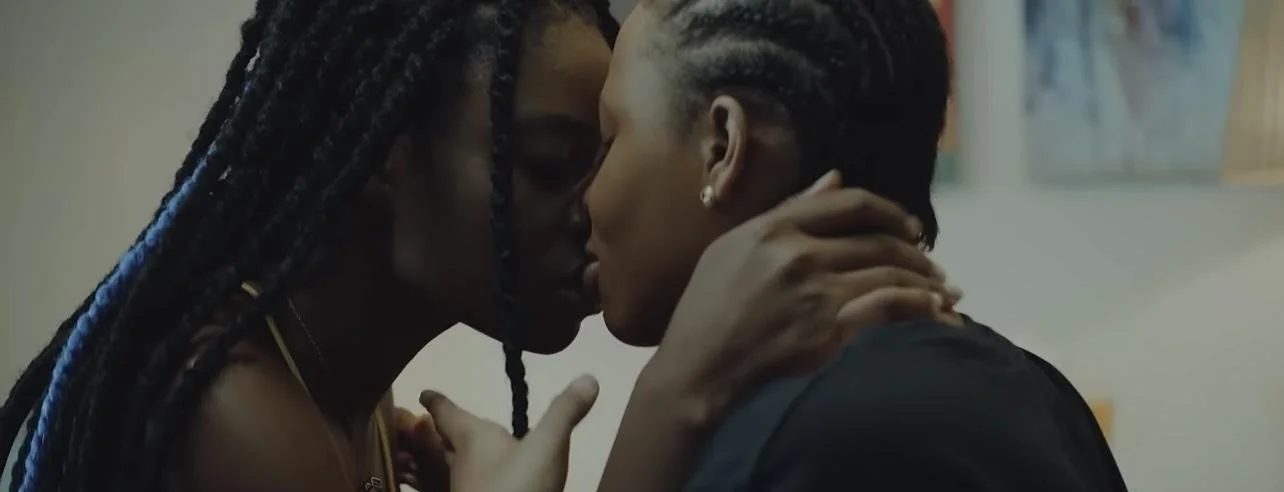
Still from Ìfé
Ìfé tells the story of two lesbians navigating normal life in Nigeria. In a July 26, 2020 CNN report by Aisha Salaudeen, the Nigerian queer film- Ìfé was threatened to be banned by the National Film & Video Censors Board (NFVCB). The NFVCB is Nigeria’s regulatory body set up in 1993 to regulate the video industry in Nigeria. The board’s role is to keep a register of all films and video outlets in Nigeria. The CNN report also highlighted that Adedayo Thomas, who is the Executive Director of the board, had sent a warning that the board will never approve films that don’t conform to the country’s constitutional expectations and morals. Ìfé was first produced in 2020, but was not accessible for public viewing until its release on YouTube in 2024. He further mentioned that the board was monitoring the film and would be forced to track the producer in any case if the film was found to break the tradition of the country.
In another report on Premium Times News on June 27, 2024, titled: Stop production of same-sex, pornographic films – NFVCB warns filmmakers, Obed David writes:
‘Stop production of same-sex, pornographic films’- NFVCB warns filmmakers: The Board says the warning follows reported cases of covert activities by some filmmakers and content creators. The National Film and Video Censors Board (NFVCB) has issued a warning to filmmakers to desist from promoting and producing films that promote same-sex relationships and pornography that contravenes the Same-Sex Marriage Prohibition Act and the NFVCB Act. The censors board said these filmmakers and content creators produce, promote, distribute and stream prohibited and unapproved content, especially same-sex content, on social media and other online platforms (David).
These background of threats help as evidence for the myriad of censorship that are obtainable for Nigerian queer filmmakers, which in turn is an intention to stifle creativity and truth, what (Hammonds) had described as the silencing, erasure, and invisibility of female sexuality.
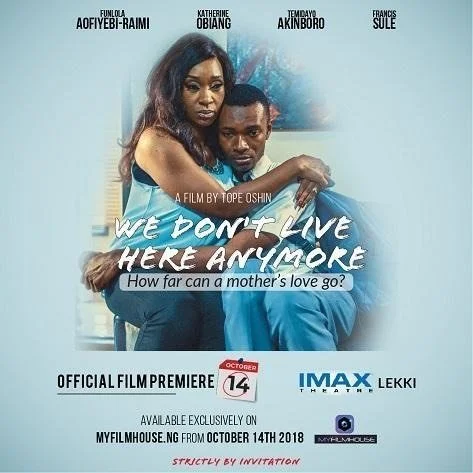
Poster for We Don’t Live Here Anymore (TIERS Nigeria, 2018); source Red Media Africa
In October of 2018, I was at the IMAX Lekki Theatre in Lagos for the official premiere of the film We Don’t Live Here Anymore (WDLHA). Through two teenage boys in love, the film captures an in-depth look at violence both in the family and community faced by persons who do not necessarily fit into the heteronormative norm that is the known tradition in Nigeria. The film was produced by Olumide Makanjoula, Bose Oshin, and Tope Oshin. It was my first time seeing a Nigerian queer film that was not the criminalization that I had seen through mainstream Nollywood. On the day of the premiere, tons of celebrities, actors, and non-for-profit workers filled the theatre. I didn’t think it was going to be that huge before I walked in. The cast were excellent, the cinematography was clean, and all over the theatre, there was an air of decorum and organization, such that the premiere was as important as the story. It interested me how this story of two homosexual boys had attracted this whole crowd. I had never been exposed to such an event in Nigeria before.
Both before and after the screening, everyone seemed to know each other, the obvious presence of community, and then there was a brief panel on stage that allowed some of the actors to appear and speak. What struck me was the freedom and joy the audience showcased in that space. I was not used to it. I didn’t realize Nigerian queer cinema could take this shape, a large room full of people watching what they have invested in and produced. But after my excitement, I was left to think of many other things such as the things that were lacking in that same space, especially the fact that only people who had access to that space were able to witness the premiere. While access might have been restricted due to potential security threats at the premiere, access also becomes restricted in the way that the film is disseminated, especially in the face of the country’s NFVCB regulatory systems. In a country as Nigeria, with hatred towards gender non-conforming people, to showcase a queer film the same way a heterosexual film is showcased or marketed might be impossible. I would therefore assume that the yearning to market or disseminate widely might be slowed down due to this burgeoning institutional and cultural restrictions.
A few months later, I was hanging out with a group of friends who didn’t get the opportunity to be at the premiere, and whom I was sharing my excitement with. I had told them many good things about the film and the fact that it was queer, bold, and seemed like a lot of funds had gone into its production. I had seen this through the rich casting and cinematography of the film, and of course, the crowd at the premiere. First, some of the cast were already well known Nigerian actors, which means they have been paid accordingly; second, the Director, Tope Oshin, has produced Fifty and Wedding Party 2, some of the early Nigerian films on Netflix. Selected Netflix movies coming from Nigeria are usually top rated and up to an international standard. This is equally an indication that the Director had been exposed to various genres, forms and stories that exist in the Nigerian film industry. My friends wanted to see more of WDLHA after my long praises for the film, but that was not possible. All we could access was the trailer. My friends’ excitement went down because there was no need to watch a trailer and not watch the whole film even after two years later. Therefore, I will also question the demands for accessibility as I discuss these three categories of Nigerian queer film I have mentioned earlier, all of them available on YouTube. These three categories are listed below, with film samples that I will use to explain them:
Non-for-profit (Hell or High Water, 2016)
The Nollywood (Complicated, 2024)
The upcoming (Beyond the Closet, 2024)
Hell or High Water (2016)
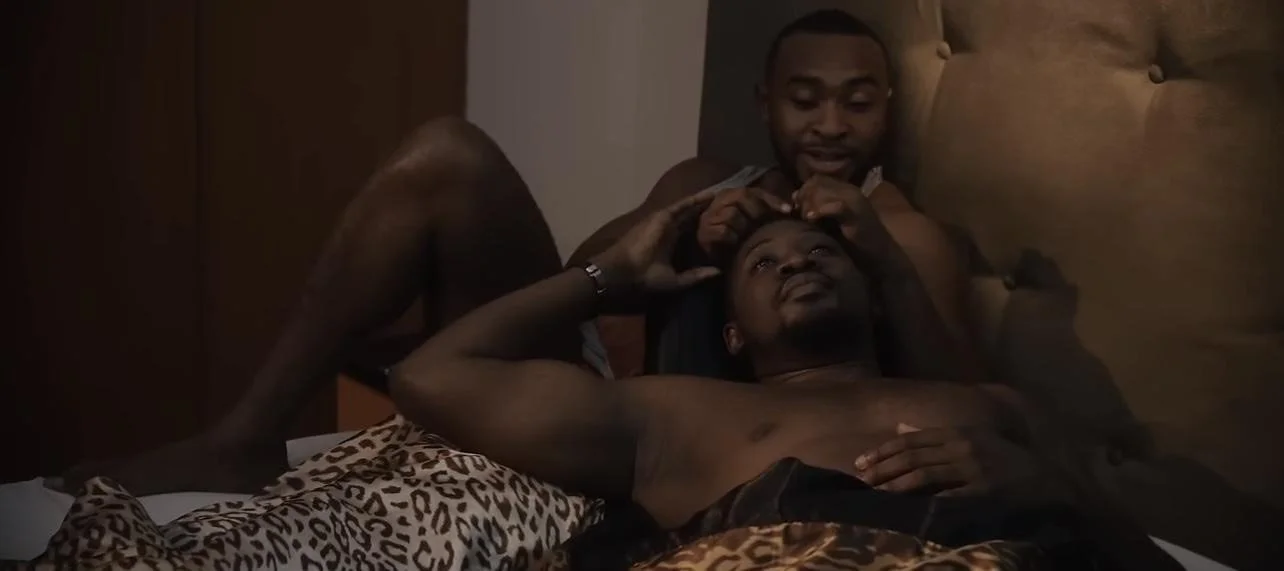
Still from Hell or High Water
Hell or High Water was released on Mar 17, 2016 on Youtube, and has 25,162 views as of March, 2025. The film tells the story of Gbolahan, a pastor who has fallen in love with another man, Kelechi. Both Pastor Gbolahon and Kelechi are married to women, but are still stuck with love they had grown in the past. Pastor Gbolahan is loved by his church members, his family and friends, but he worries about the disappointment that would come the moment he is known to be a homosexual. When the news of his sexuality spread to the community and the church, he is divorced by his wife and disowned by his father. The film, which shows the possibilities of life in the middle of sexuality and spirituality, does so with the aim to challenge the stereotypes always associated with sexuality and spirituality. The film does not present spirituality in isolation, but shows how, for example, Gbolahan is not just a pastor, but also a homosexual man struggling with his sexuality and masking his truth through a heterosexual marriage. The film also uses popular faces and known actors, which I have noticed is a strategy for films under this category. The use of known actors requires the funding to pay those actors, which does not come as easy for other categories, but which helps in driving public attention to the film as reception and disseminations continue to be a major deliverable under any film category.
Complicated (2024)
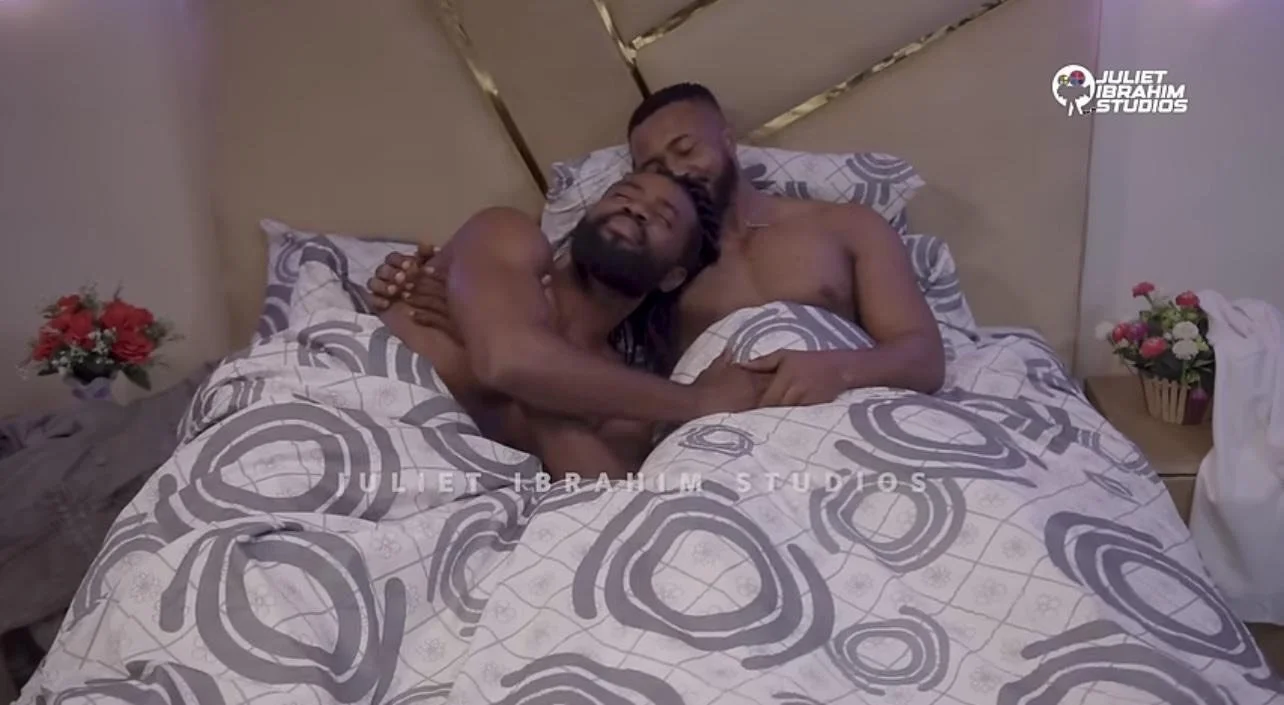
Still from Complicated
The film, screened on YouTube and produced by popular actress, Juliet Ibrahim- who has also publicly spoken against homophobia through her social media platforms- argues there is a need to confront the silencing of queer stories through film. Complicated follows two men, Kelvin and Timmy, neighbors who find themselves in a sexual affair they can't comprehend. Kelvin falls in love with Timmy’s best friend - Linda -, also as a strategy to get closer to Timmy. While they begin their relationship, he falls in love with Timmy, and comes out as bisexual. Linda finds out about their affair and this affects her friendship with Timmy. What interests me is the clear portrayal of bisexuality in the film, the ability for Kelvin to act genuinely in love with these two friends. I highlight this film as an example for this category because of its closeness to what constitutes Nollywood films, especially multiple characterization and length.
Beyond the Closet (2024)
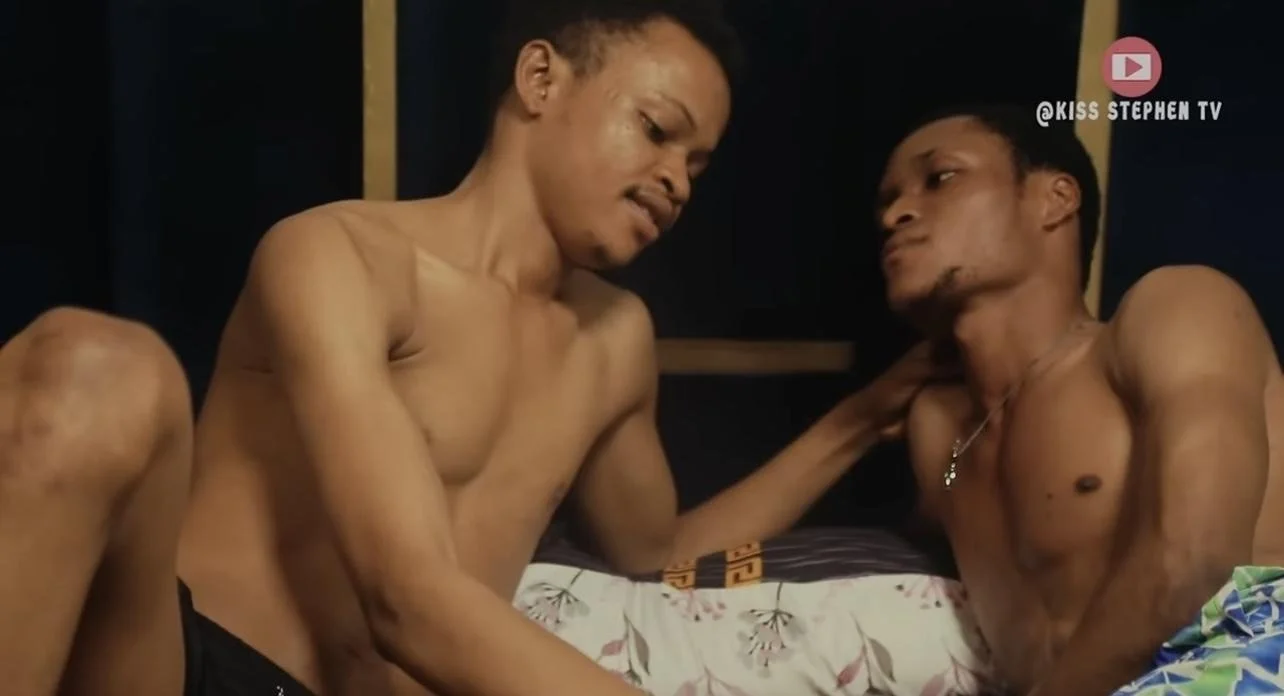
Still from Beyond the Closet
I use Beyond the Closet to represent a wave of new queer Nigerian films on YouTube, mostly filled with highly independent acts and investments, most of them filmed at one location, most of them ridden with poor storylines, most of them full of unskilled actors. But it is important to acknowledge the role that the existence of these films play. The films embody an ethical representation of queer persons in Nigeria and does not use any form of discriminatory rhetoric in its characterization or dialogues. My interest in Beyond the Closet focuses on the film’s methodology to capture respect and acceptance, especially from family and friends.
Closing Notes
Although I have mentioned Ìfé earlier as not being accessible until a certain period, it is also important to note that the inaccessibility was based on restrictions and censorship that enveloped the Nigerian film industry, thereby putting film producers, actors, and organizations at the risk of unwanted and unconstitutional arrests. The three films that I have shared so far are what I would grade under Nigerian queer films, films made with intentions of confronting homophobia, either in calling out violence, hate, or by ethically highlighting the experiences of queer Nigerians with the goal to counter homophobia. These films further do well in answering the needs of queer folks in the country who do not get the chance of looking through what their lives might seem like through visuals.
I want to reiterate that my argument is one that acknowledges the present terrain and landscape of Nigerian queer film and therefore advocates for more films that move outside of traditional gatekeeping to embrace options that are more grassrooted, paywall-free and most of all, an umbrella that captures and tells the truth about all versions of queerness through the visual, this truth that Hammonds (308) has spotlighted as what needs to be presented rather than concealed. These three films that I present above, regardless of their different shortcomings in terms of production and delivery, serve as an archive that upholds the truth, the existence of queer Nigerian lives and the power that showcasing that existence holds.
I propose a Nigerian queer film genre that tells the truth in all forms, one that captures an entire representation of Nigerian queer life. Like Savannah Shange’s quote from her 2019 essay, Play Aunties and Dyke Bitches: Gender, Generation, and the Ethics of Black Queer Kinship: (what we need is) “a portal of Black queer life— a sort of wormhole that captures a series of slippages between girlhood and grownness, dykes and dudes, masculinity and manhood, public and private, then and now, me and you, love and war” (41).
Works Cited
Akinwotu, Emmanuel. “‘Ìfé’: The Queer Love Story Defying Nollywood and Nigeria’s Censors.” CNN, 11 Dec. 2020,
www.cnn.com/style/article/ife-queer-film-nigeria-intl/index.html.
Cohen, Cathy J. “Deviance as Resistance: A New Research Agenda for the Study of Black Politics.” Du Bois Review: Social
Science Research on Race, vol. 1, no. 1, 2004, pp. 27–45.
DeClue, Jennifer. “Theorize for What? Reading Black Queer Film and Popular Culture.” Palimpsest: A Journal on Women,
Gender, and the Black International, vol. 9, no. 2, 2020, pp. 43–54, doi:10.1353/pal.2020.0024.
Green-Simms, Lindsey B. Queer African Cinemas. Duke University Press, 2022, doi:10.2307/j.ctv2bgz3dq.
Hammonds, Evelynn M. “Black (W)holes and the Geometry of Black Female Sexuality.” differences, 1994.
Ikpe-Etim, Uya. Ìfé. YouTube, 2020, youtu.be/0LhvJGa4BP0.
Iwe, Patrick K. Beyond the Closet. YouTube, 2024, youtu.be/eonrB0WYAw4?si=2GmWgocWM-bzYODE.
Komolafe, T. Complicated. YouTube, 2024, youtu.be/BWIcVLL-7HA?si=7AIu6G-H45r1ehel.
National Film and Video Censors Board (NFVCB). “About Us.” NFVCB, n.d., www.nfvcb.gov.ng/about-us/.
Okanlawon, Kehinde. “Cultures of Public Intervention Regarding LGBTQ Issues after Nigeria’s Same-Sex Marriage Prohibition
Act (SSMPA).” College Literature, vol. 45, no. 4, 2018, pp. 641–651.
Parkerson, Matt. “Birth of a Notion: Toward Black, Gay, and Lesbian Imagery in Film and Video.” Sisters in the Life: A History of
Out African American Lesbian Media-Making, edited by Yvonne Welbon and Alexandra Juhasz, Duke University Press, 2018,
pp. 21–25, doi:10.1515/9780822371854-004.
Premium Times. “We Will Track Down Producers of Lesbian Movie – Nigeria’s Censors Board.” Premium Times, 4 July 2020,
www.premiumtimesng.com/entertainment/nollywood/401890-we-will-track-down-producers-of-lesbian-movie
nigerias-censors-board.html.
Premium Times. “Stop Production of Same-Sex, Pornographic Films – NFVCB Warns Filmmakers.” Premium Times, 7 Feb.
2024, www.premiumtimesng.com/entertainment/nollywood/707730-stop-production-of-same-sex-pornographic-films-
nfvcb-warns-filmmakers.html.
Red Media Africa. “The Initiative for Equal Rights Premieres Captivating Feature Film ‘We Don’t Live Here Anymore.’” Red
Media Africa, n.d., redmediaafrica.com/the-initiative-for-equal-rights-premieres-captivating-feature-film-we-dont-live-
here-anymore/.
Shange, Savannah. “Play Aunties and Dyke Bitches: Gender, Generation, and the Ethics of Black Queer Kinship.” The Black
Scholar, vol. 49, no. 1, 2019, pp. 40–54, doi:10.1080/00064246.2019.1548058.
The Rustin Times. “A Recap of All That Happened at the Premiere of ‘We Don’t Live Here Anymore.’” The Rustin Times, 15 Oct.
2018, therustintimes.com/2018/10/15/a-recap-of-all-that-happened-at-the-premiere-of-we-dont-live-here-anymore/.
QUOTE AS:
Chimee Adịọha. Archiving Truth: Monitoring the Nigerian Queer Film. The Living Commons Collective Magazine. N.4, March 2026. p. 69-84
