Demonic Waterways: Where Past Struggles and Present Refusals Converge in an Endless Current of Future Possibilities
The Women of Rios Unidos
by
Paula Lezama
Introduction
En el Pacífico la vida
la sostienen las mujeres
por los caminos del agua
con la esperanza del verde
De mar y de río son los caminos,
de las mujeres son las historias
navegantes que caminan
con la luz de la memoria.
Aura Elena González Sevillano, Excerpt from Los Caminos del Agua1
In the Pacific, life
is sustained by women
along the paths of water
with the hope of the green
of sea and river are the paths
of women are the stories
navigators who walk
in the light of memory.
Aura Elena González Sevillano, Excerpt from Los Caminos del Agua
Translation by the author
The Colombian Pacific coast spans over 1,300 kilometers. It is a rugged region stretching along the western edge of the country, from the Pacific Ocean in the west to the Andean mountains in the east. A tropical climate, dense rainforest, mangroves, swamps, and extensive river systems characterize it. Its tropical climate with high humidity and rainfall makes it one of the wettest places on Earth and the second most biodiverse. The region is home to Colombia’s largest Afrodescendant population, with a history and culture deeply intertwined with the land, the sea, and the rivers. As Dawson and Oslender note, aquatic geographies like the Colombian Pacific are central to the African Diaspora, as they have long served as central arenas where Black communities negotiate history, survival, and resistance.
The region has been shaped by a colonial legacy of extraction that continues to shape everyday life. Here, a stark paradox endures: The region, abundant in ecological richness, remains marked by deep precarity as its natural wealth is steadily pulled out for external profit (Leal; Escobar, Territories of Difference; Escobar, “Displacement”). It is a geography of colliding currents, where extraction, environmental degradation, political abandonment, and resistance intersect.
In this context, we encounter Las Mujeres de Ríos Unidos, a community enterprise comprised of over 100 rural Afrodescendant women and their extended families working together in the southern Colombian Pacific for over 25 years. Rios Unidos emphasizes a collective work model that revindicates the cultural, environmental, and spiritual wealth of Afro-descendant communities. Their oral histories and songs tell us about productive capacities, the songs of alabaos tell us about deaths and wake labor, and the arrullos announce births. Their rituals are all traversed by the symbolism of water, promoting a harmonious co-existence with both the natural and socio-cultural environment. It is within this lived landscape that my reflections take shape.
While my dissertation focuses on exploring Rios Unidos’ subsistence practices and collective organizing as alternatives to racial capitalism and Homo Economicus2 prescriptions; in this essay, I am meditating through the writings of Aura Elena and my interactions with her, the women, their cultural expressions and their territory, on how their everyday life giving praxis interspersed with the flowing currents of water and the ecologies of the Colombian Pacific. Their practices constitute not merely a refusal to latent destierro3—the constant threat of being torn from the land and its life-giving resources and communal practices—but a commitment to nourishing radical hope. This hope, beyond sentiment, is a live practice from which creative possibilities for the future emerge.
Aura Elena Gonzalez Sevillano, coordinator of Ríos Unidos, social activist, and writer, expresses clearly the symbolism of water for her people.
En los ríos del Pacífico los caminos son de agua. La vida es navegar siempre y sin parar. El agua es a los sentidos como el aire es a la vida. Se funde en uno quien el Pacífico habita, desde el tiempo de nacer hasta el día de fallecer. (Gonzales Sevillano, “Los Caminos del Agua”)
“In the rivers of the Pacific, the paths are made of water. Life is a constant, non-stop navigation. Water is to the senses what air is to life. It merges into one with he who lives in the Pacific, from the moment of birth until the day of death.” (Translation by the author).
For Sylvia Wynter, the demonic signifies a site of radical transformation where everyday practices become critical tools to create new subjectivities and histories outside the constraints of hegemonic power (Wynter, “Beyond Miranda’s Meanings”; Wynter, “Unsettling the Coloniality of Being”; Wynter and Scott; McKittrick, Demonic Grounds). In line with Figueroa-Vasquez’s concept of destierro, which extends beyond mere displacement to encompass the severing of people from their territories, communities, histories, and place-based identities, las Mujeres de Ríos Unidos refuse the ongoing destierro prescribed by colonial frameworks. They do so through their ancestral knowledge, storytelling, (re)productive capacities, and joy. Importantly, their praxis cannot be reduced to resistance; rather, these are powerful affirmations of their subjectivities and cosmologies, asserting their genre of humanness in the process. Water, as a literal force of transgressive continuity, represents their past and present struggles, and the unbounded potential of rural Afro-Colombian women for re-imagining life in the face of ongoing violence.
Ecologies of the Black Pacific: Diaspora in Flux
I first met Aura Elena Gonzalez Sevillano, Rios Unidos coordinator, in 2011. Over the years, I attempted to visit her in Guapi, Southern Colombian Pacific, several times, but the armed conflict’s constant disruptions of public order—and my own life permanently in the US—kept the trip out of reach. Yet, across the distance, we nurtured a close friendship. Through Aura’s stories, I was carried into places that los de afuera speak of as unlivable, but los de adentro, whose existence is braided into the rivers, tides, and mangroves, are understood as paradise4. For them, being is territorial; the Pacific is not mere scenery but the ground of their ontology. Her storytelling, then, opened portals: La Casa del Rio, the transformation center of Rios Unidos, the pulse of the mangrove. I travelled metaphysically long before I arrived.
I left home in the US to go home to Colombia—a home from which I have also been desterrada. The poverty and the senseless violence that had mutilated my home and my hopes at a younger age were still there, but in Guapi, the senseless violence was met not only by despair and guns but with song, dance, rain, and ritual. Aguarotecas—improvised celebrations that erupt under the sudden tropical downpours—filled the air with laughter and dance. Balsadas, the traditional lighted boat processions honoring the Virgin Mary and Jesus, moved slowly along the river like floating prayers. Women tending to their azoteas, the raised household gardens where medicinal plants, herbs, and everyday food are grown. At dawn, people fish along the banks, and by late afternoon baños de aguas frescas—cool baths infused with herbs and medicinal plants—to cleanse the body of the heat and wandering energies. Here, daily life unfolds with the rhythm of the tides, carrying practices from time past that heal, sustain, and gather the community into itself—and I felt I had arrived in a place I somehow already knew, yet one that called me into a future still forming.
The name, Rios Unidos, stems from the three rivers that crisscross Guapi–the rivers Napi, San Francisco, and Bajo Guapi —which emptied into the Pacific as they sustain multiple communities along their banks. A handwritten poster by the women depicts the symbolism of these rivers alongside what they call the Nato Tree, or Mora Oleifera. Although Nato is not a true mangrove species, it grows in the freshwater and brackish zones that border mangrove ecosystems, where its massive buttress roots help stabilize soft waterlogged soils and reduce erosion alongside the riverbanks. By moderating freshwater flow and contributing organic material to the forest floor, Nato supports the health and resilience of the mangrove environment. Its towering presence shelters a diversity of species and forms part of the ecological buffer that protects the coastal life from environmental stress (Guevara-Mancera et al.). For the women, the Nato becomes a living metaphor for interdependence, protection, and regeneration—an emblem of their collective strength and their capacity to nourish in shifting, tidal geographies.
Collage 1. Nato Tree Roots and Poster from Las Mujeres de Ríos Unidos*
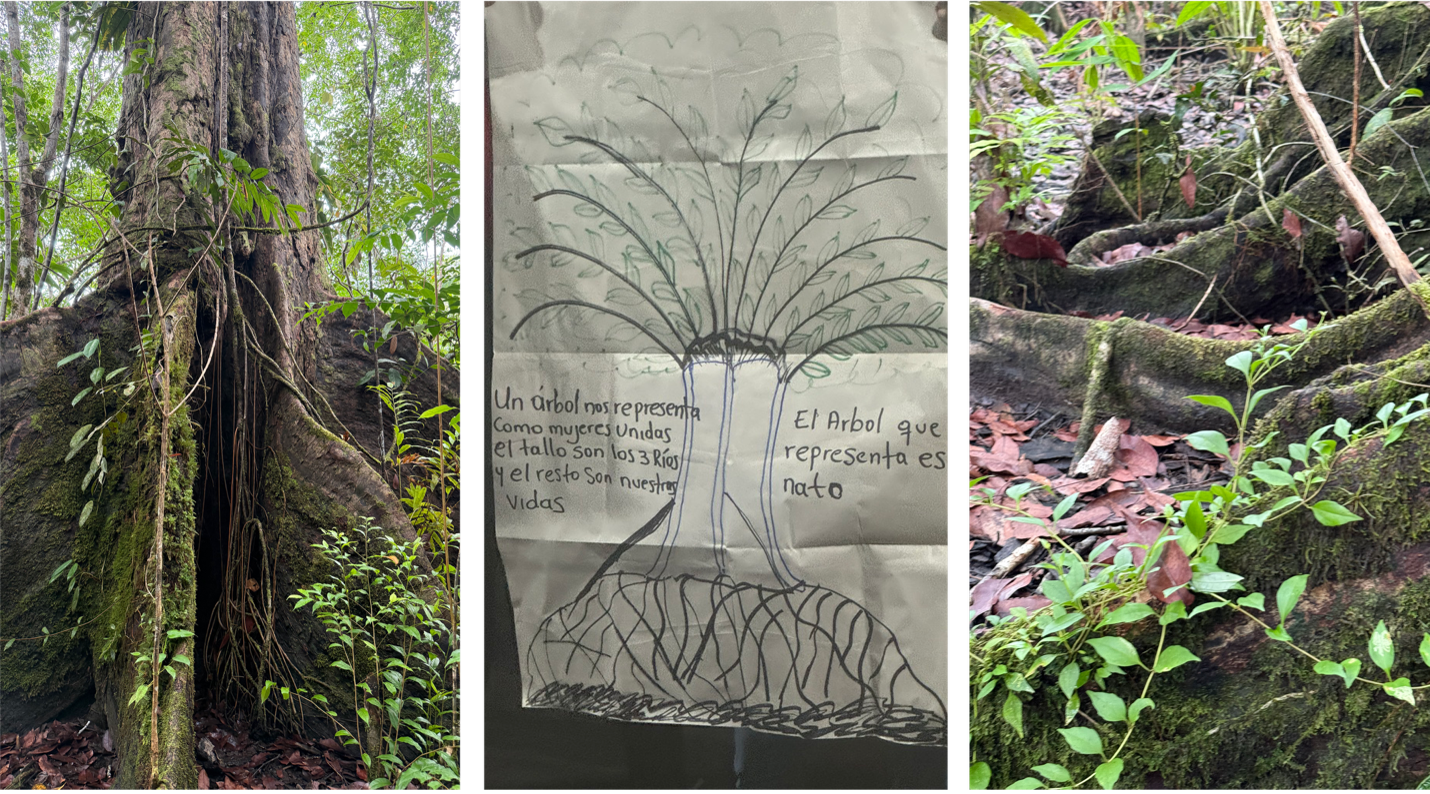
Sources: Photograph taken by the author during the fieldwork of 2024-2025. The poster depicts their logo, a Mangle Nato developed by the Las Mujeres de Ríos Unidos. A tree represents us as women united; the stalk is the three rivers, and the rest are our lives. The three that represent us is the Nato. Text translated by the author.
Rios Unidos is a community enterprise comprised of smaller rural groups of women across the three rivers of Guapi. They have been working together since the early 2000s in various collective initiatives that culminated in the official creation of the community enterprise in 2009. Rooted in the histories of the Afrodescendant communities along the Pacific, Rios Unidos promotes the balanced use of their natural wealth and biodiversity, with a focus on revindicating their traditional practices of social organization based upon trust and solidarity. Besides a line of psychotherapeutic products informed by their ancestral ecosystemic knowledge, the community enterprise supports the various women’s groups in other productive activities, including harvesting fruit trees, chondatudoro, coconut, plantains, and livestock activities, mainly poultry, and fisheries. However, productive practices are not a separate sphere as in mainstream economics. On the contrary, productive practices are woven through everyday life-giving practices such as cooking, caring for the children and the elderly, spiritual rituals, and community building. Just like the Nato, which supports life along the edges of the mangroves and helps sustain the transitional ecosystems of the Pacific Lowlands, Las Mujeres de Ríos Unidos support life in their communities. There is a firmly rooted yet always in flux, shaped by shifting tides, histories, and the everyday labor that nourishes collective existence.
The following quote emphasizes the literal and figurative importance of the river and waters for the women of the Colombian Pacific. Figuratively, the river provides them with the breath of life and fortitude, serving as the site of reference for their identity and community belonging. Literally, through their everyday subsistence practices, the water also provides them with their livelihoods through hydration, fishing, and transportation, among others.
“A las mujeres nacidas en las orillas del Guapi y en los pueblos del Pacífico el río nos da el sustento, el alimento, el aliento y la templanza para vivir la vida” (Gonzales Sevillano, “Los Caminos del Agua”)
“To the women born in the banks of Guapi and in the towns of the Pacific, the river gives us sustenance, food, the breath of life, and the strength to live life” (Translation by the author).
Collage 2. The River, Mangroves, and Community Life
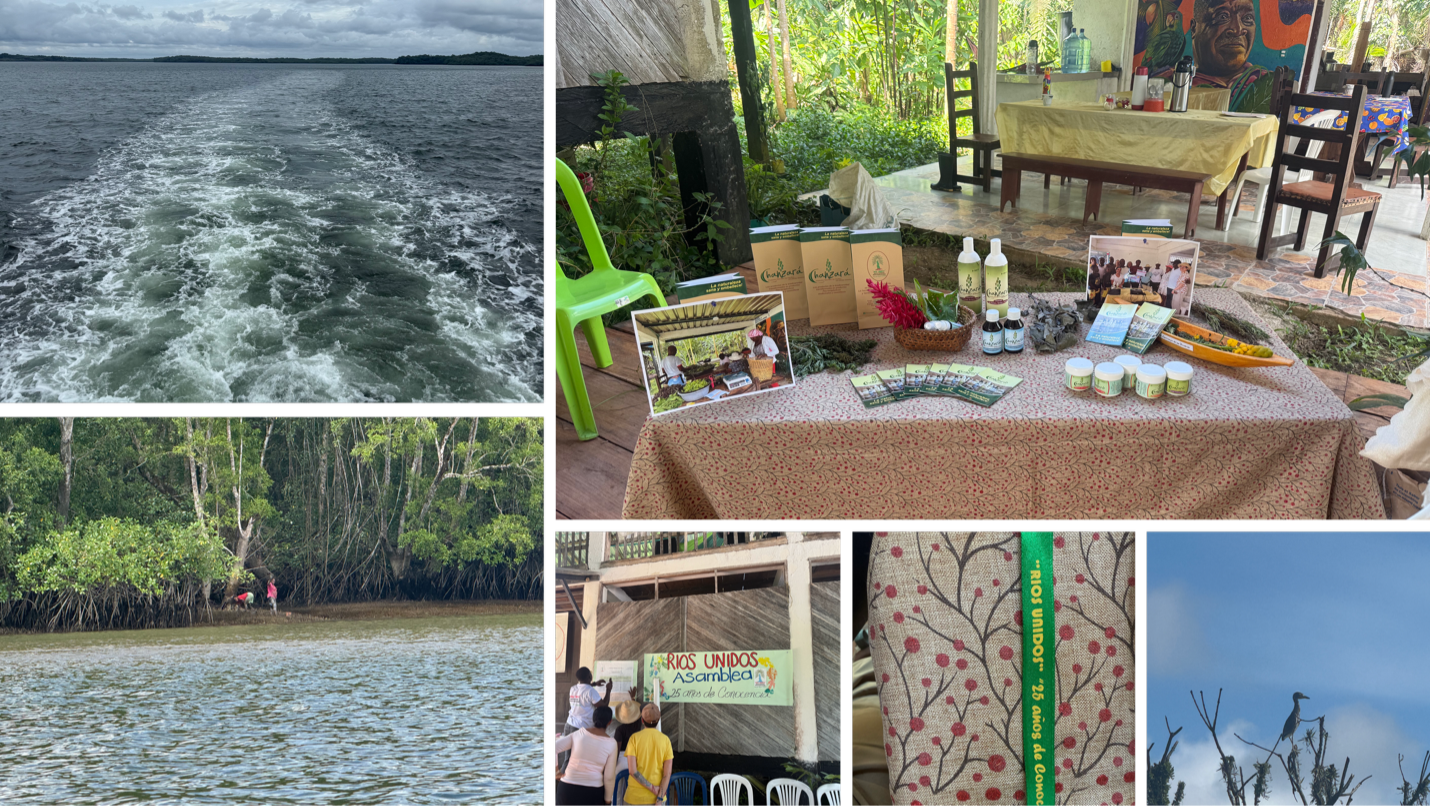
Source: Photos taken by the author on various fieldtrips 2022-2025. A Collage of waterways, mangroves, labor, plants, and communal life shaping the ecologies of Rios Unidos.
As Lethabo King states, water has long been used as a metaphor to represent Black fluid subjectivities, invoking movements that exceed Western notions of fixed space and linear time, articulating the shifting, tidal nature of Black diasporic life (Lethabo King). For Las Mujeres de Ríos Unidos, the waterways of Guapi—the confluence of rivers and ocean held within the mangroves—embodied both ecological sustenance and resistance, and a praxis of endurance. These waters carry the weight of historical dispossession and the ongoing demands for racial justice, environmental care, and territorial sovereignty. Yet, they also exceed the logics of damage. Moving in the demonic register Wynter identifies, the women’s practices gesture toward other genres of being—toward futures that erupt not from state recognition but from the ancestral, the communal, the tidal, everyday life. These ecologies, thus, are not simply sites of survival; they are laboratories of possibility where the afterlives of slavery meet the currents of worlds otherwise, carried forward by Black women’s steadfast, life-giving labor.
Demonic Waterways toward Futures Past: Black Women’s Refusal of Destierro
Since colonial times, the enslaved Africans in the Colombian Pacific relied on their skills and ingenuity not only to endure the brutality of slavery but to make the region’s lowlands livable when colonial authorities failed to do so. After emancipation, they continued building social, cultural, and ecological worlds beyond the purview of the republican state, which remained focused solely on the extraction of raw materials (Leal; Escobar, “Displacement”; Escobar, Territories of Difference). This long history of imposed dispossession forms the sediment upon which today’s struggles unfold. It is also where the demonic, in Wynter’s sense, begins to glimmer: the ongoing capacity of Black people to recreate being, meaning, and community outside the genres violently imposed upon them by Man2 hegemonic power(Wynter, “Beyond Miranda’s Meanings”; Wynter, “Rethinking ‘Aesthetics’”; Wynter, “Development Teology”; Wynter, “Unsettling the Coloniality of Being”).
By the 1980s, the region’s global visibility grew, driven by its rich biodiversity and the extractivist agenda, including the ambitions of the armed groups, who saw the area’s strategic location close to the Panama Canal as key (Leal; Asher; Escobar “Displacement”). The arrival of ‘developmentalism’ further disrupted both the ecological system and the livelihoods of the region’s inhabitants. While the extraction of their natural wealth was a constant practice since colonial times, the rise of neoliberalism magnified the plundering. The exploitation of the region’s ecological systems, including its inhabitants, reached new extremes, resulting in major environmental degradation and social fracture. Local communities not only faced exclusion from the decision-making processes but also experienced further marginalization/extermination, and a complete disruption of their ways of life (Escobar, “Displacement”; Escobar, Territories of Difference; Perez Corredor). Accumulation by dispossession, as Harvey notes, is not incidental but foundational to capitalism (Harvey); yet it is Black radical thinkers who clarify that this process is fundamentally racialized, rooted in the afterlives of slavery and the ongoing production of differential value and vulnerability (Robinson; Chakrabarty and Ferreira da Silva; Gilmore; Koshy et al.).
The ongoing conflict in Colombia, both cause and consequence of racial capitalism, has had devastating consequences in the Pacific Region, sadly worsening after the peace accords with FARC in 2016 (Lezama and May). This intensification is not subsidiary, given that racial capitalism depends upon the differentiated value of life; Black and Indigenous territories are especially vulnerable to militarized control and extractive ventures. In the Pacific, FARC’s demobilization created a territorial vacuum rapidly occupied by paramilitary groups and criminal networks competing to control the profitable illegal economies. Sayak Valencia’s notion of Gore Capitalism helps illuminate this shift: a political economy in which bodies, territories, and their destruction become commodified, and violence itself becomes a market-based instrument of accumulation.
By 2023, the Inter-American Commission on Human Rights reported that 90% of forced displacement originated in the Pacific region, where Afrocolombians account 45% of those expelled and about 37% of those forcibly confined5. Within this framework, the Pacific—already marked by centuries of racialized dispossession—became even more desirable terrain for those seeking profit through the circulation of drugs, weapons, and fear. Thus, the post-accord period did not alleviate racialized violence but deepened it, exposing Afrodescendant communities to intensified displacement, confinement, and territorial fragmentation.
The ongoing threat of destierro, is, therefore, not only historical but continually enacted. As Yomaira Figueroa-Vásquez reminds us, destierro functions as a palimpsest of overlapping histories, lived experiences, land-based practices, and forced migrations (224). Across centuries, from the Middle Passage to contemporary times, Black people in the Colombian Pacific have lived within the haunting, latent possibility of removal. Yet, their daily lives continue to flow from past to present and back again, refusing the finality of uprooting.
The following quote highlights the crucial role that subsistence practices, community trust, and solidarity play in maintaining a strong sense of belonging to their territory. Even as they faced the threat of forced displacement, it underscores the idea that displacement is the last resort. This solidarity serves as an anchorage to their territory, creating a sense of resilience and mutual care that is far more valuable than fleeing, although fleeing is sometimes their only option for survival.
“Entonces, para un desplazamiento para nosotros ya es el último grado para uno venirse porque uno ve, sea como sea, con miedo o no, tienen donde echar sueño. El día que pudo, se fue al monte y trajo [comida]. Si uno no puede ir, el vecino trajo y lo comparte. Entonces, es mucha mejor opción que venir acá.” (Entrevista, asociada fundadora de Ríos Unidos, trabajo de campo, verano de 2024).
“So, for us, displacement is already the last step, to go because you see, whatever it is, whether you are afraid or not, you have somewhere to sleep. The day that you can, you go to the mountains and bring some [food]. If you can’t go, the neighbor brings it and shares it. So, it is a much better option than coming here [urban areas].” (Interview, founding partner of Ríos Unidos, fieldwork, summer 2024- Translation by the author).
Her words illuminate how refusal operates not only as resistance but as affirmation: the daily reproduction of life, care, and belonging. These practices enact a genre of the human that Wynter and other radical thinkers insist we must recognize as an ongoing rewriting of the Black being against the violences that seek to erase it (Wynter, “Beyond Miranda’s Meanings”; McKittrick, Human as Praxis; Hartman; Sharpe). Las Mujeres de Ríos Unidos remain strong and fertile like the Nato tree standing tall and strong in the shifting, waterlogged soils of the Pacific lowlands. Their presence endures despite pressures from state forces, guerrillas, paramilitaries, and cartels. Black Ecologies reminds us that the African Diaspora continues to be haunted by the spectral wake of the transatlantic crossing, yet this haunting is met with a constant celebration of life.
Rinaldo Walcott describes the ‘Black Aquatic’ as the historically complex and often contradictory relationship Black people have had with water (Walcott). This connection has been lived, imposed, feared, and reclaimed as essential to Black peoples’ subjectivities. Early republican elites, as Leal recounts, characterized the people inhabiting the Pacific as indolent and immoral. As Leal quotes, "…in close contact with the mud of the animals." (224), projecting a racialized ontology of subhumanity. This deficit gaze stands in stark contrast to what Aura Elena describes: a closeness to water as a site of belonging, of art making, and fluid memory. Water, whether rain, fresh, or saline, is a vital force that shapes both individual and collective identities. Just as it flows connecting various places, it intertwines the histories and stories of the people, linking family names, traditions, and practices passed down through generations. The fluidity of water, thus, mirrors that of memory as it shapes the collective consciousness of the peoples of the Colombian Pacific. For women, this connection is central, as they have historically nurtured their communities and passed down ancestral knowledge through generations.
“Aquí, el río donde nacemos determina el gentilicio y suscribe identidades territoriales (guapireño/a, napireño/a, guajuireño/a). También demarca a la familia extensa con su repertorio de apellidos, y las historias de pobladores, que exaltan los oficios varios donde se mezclan el laboreo y el arte de mujeres y hombres. En la memoria colectiva pervive la historia del agua: forma los caminos que llevan y traen la esencia de quienes hemos aprendido por siglos en los extensos ríos que viajan, desde las cabeceras hacia las bocanas y las imponentes playas entre exuberantes esteros poblados de mangle y de barro.” (Gonzales Sevillano, “Los Caminos del Agua”)
“Here, the river where we are born determines our demonym and subscribes to territorial identities (Guapireño/a, Napireño/a, Guajuireño/a). It also demarcates the extended family with its repertoire of surnames and the stories of inhabitants, who exalt the various trades where the work and art of women and men are mixed. The history of water lives on in the collective memory: It forms the paths that take and bring the essence of those who have learned for centuries in the extensive rivers that travel, from the headwaters to the estuaries and the imposing beaches between exuberant marshes populated by mangroves and mud.” (Translation by the author).
Nato trees grow along the muddy edges where mangrove ecosystems meet higher ground. These transitional zones provide the dense, moisture-rich soil that supports their roots and helps protect surrounding areas from tides and storms. This mud—neither fully solid nor fluid—mirrors the layered complexities of Black resistance. It evokes the liminal spaces in which, despite the ongoing oppression, Black communities have forged new identities and cultural expressions that honor both their past and their present, even as they continue to face persistent violence.
The following image, discarded as scarce and deficient from the outside, captures the complexities of life in the paradise of Las Mujeres de Ríos Unidos. A palafito6 house stands above the muddy shore. Its wooden stilts connect the structure to the earth, rooted in the plush landscape of the rainforest. In the foreground, a canoe rests on the edge of the riverbank, its presence a reminder of the intimate relationship between the people, the water, the land, and memory. This in-between terrain mirrors the complexities of Black existence in the Americas: forged in liminality, shaped by violence, yet generative of new lives, identities, practices, and joy.
Image 1. Riverbanks and Mud: Black Lives in Flux.
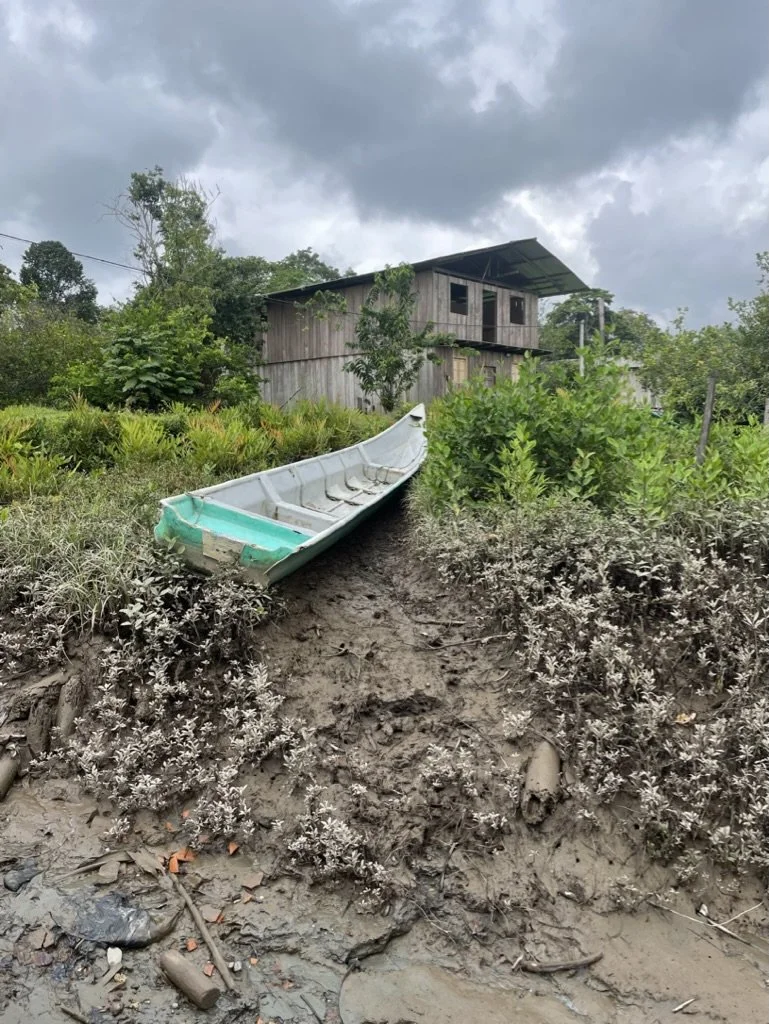
Source: Field trip Summer 2024, taken by the author.
Much like Blackness, the muddy shore with its ever-shifting boundaries between land and water, refuses easy classification. The palafito itself, elevated above the water and mud, stands as a symbol of knowledge and resilience. Like the mangroves, which adapt to moving tides and saline environments, the house is a product of survival and adaptation. The house and the mangrove stand together as an architecture of survival, an aesthetic of endurance, and a geography of joy through which Black life continues to create itself against the ongoing violences it confronts.
Beyond Happiness: Black Joy as Radical Hope
“Sube, sube, sube, sube sube la marea, sube la marea, sube la marea ahh.
Ahí viene jugando, subiendo el agua, anegando los barriales,
anegando los manglares, porque sube la marea ah ah ah!
Ahí vienen los pescadores con sus velas en la proa,
con su chinchorro y atarraya porque sube la marea,
sube la mare, sube la marea ahh
Alla están los chichorreros con el agua en la cintura
Cogiendo todo pescado y forman la algarabia
porque sube la marea, sube la mare, sube la marea ahh…”
(Excerpt/Lyrics from Sube la Marea by Socavon the Timbiqui)
“Rise, rise, rise, rise, rise the tie, rise the tide, rise the tide, ahh
Here it comes, playing, rising the water, flooding the mudflats,
Flooding the mangroves because the tide is rising, ah ah ah!
Here comes the fisherman, with their sails at the bow
With their nets and seines, because the tide is rising,
rise the tide, rise the tide, ah
There are the netters with water up to their waist,
Catching all the fish and making joyful noises,
Because the tide is rising, rise the tide, rise the tide ahh’’
(Translation by the author. Excerpt/Lyrics from Sube la Marea by Socavon the Timbiqui)
The rising tide in Socavón’s song is not simply a natural event. It is the pulse of a people whose lives have long been shaped by the ebb and flow of water. The tide brings movement, labor, abundance, and noise; it floods the mangroves, lifts the canoes, and sets the rhythms of fishing, cooking, healing, and celebration. In the song, the tide gathers people into collective action, chinchorreros waist-deep in water, fishermen with nets, voices blending into joy. This is not happening as sentiment, but joy as praxis, emerging from deep relational ties between people, land, memory, and water. It is a joy that has survived and helped survive people across time through the conquest, enslavement, and the long-lasting afterlives of racial capitalism.
The tidal nature of the rivers in Guapi shapes every aspect of daily life. Communities, long adapted to the rhythms of the tides, use their ancestral knowledge to guide their everyday activities from fishing, transportation, and agriculture to their cultural and sacred practices. In this scenario, Afro-Colombian women in general, and the women of Ríos Unidos in particular, resemble the Nato, whose ecological presence is essential to the health of the transitional forest that borders mangroves. Its sturdy presence stabilizes the muddy soil, regulates the movement of fresh water into estuaries, and enriches the environment, sustaining a wider range of species. That is, besides the use of its exceptionally strong wood, long been valued by local communities for its durability. Similarly, the women have been at the forefront of the struggles for the survival of their kinship, the protection of the environment, and the dignified existence of their communities. Like the tides ebbing and flowing, they refuse to be confined and trapped by the neocolonial violence infecting their territories. Their ancestral knowledge of local ecosystems, cultural richness, and lived experiences illustrate how localized Black ecologies, embodied through the symbolism of waterways, offer alternative understandings of living well.
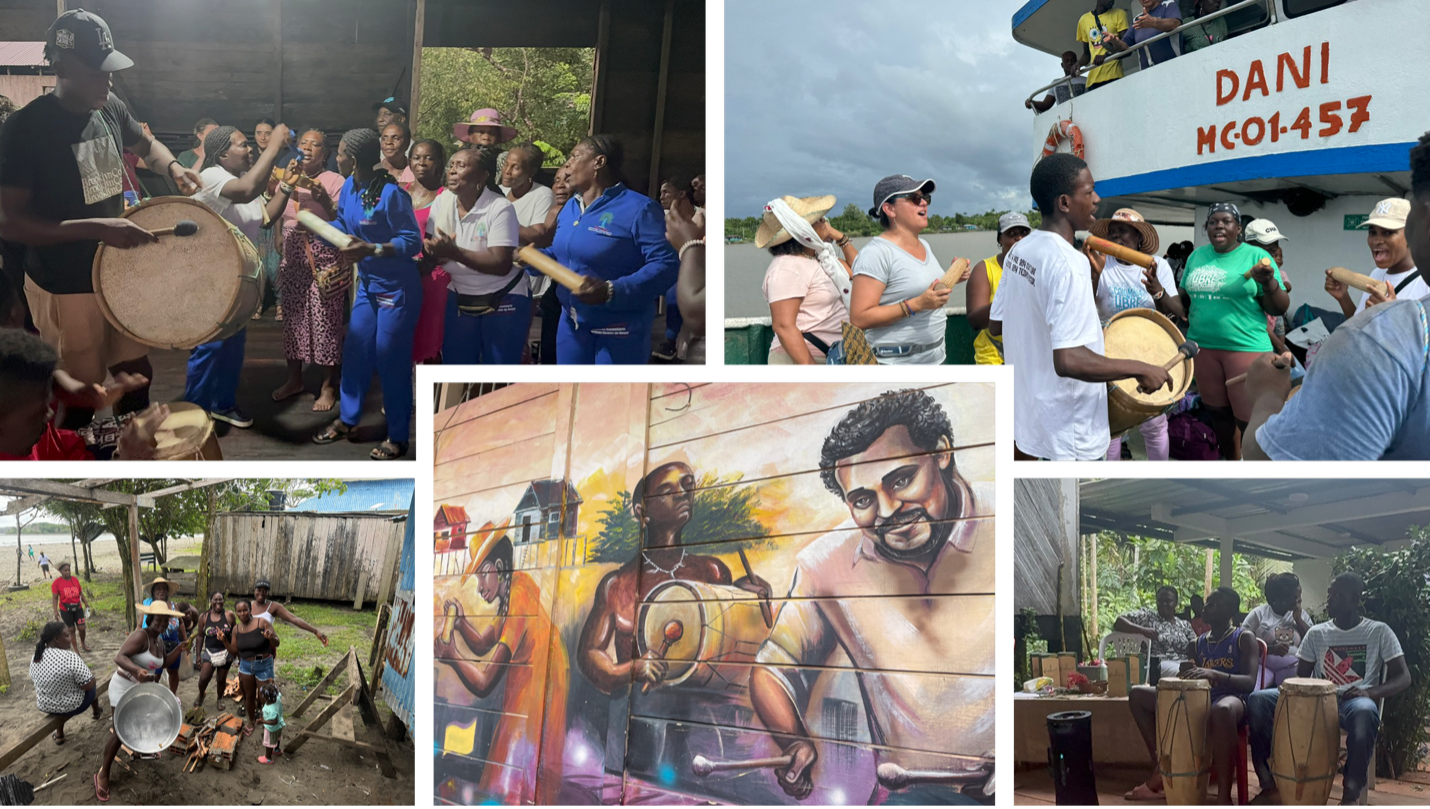
During the women’s assemblies, music and dancing were central. The drums were always ready to break the silence and to invite the people to reunite. The cununo, the bombo, and the waza filled the air from the early morning, calling people in and setting the rhythm that would guide the entire day. As people gathered, the new generations would play the drums, others joined in song, and soon the whole community was moving together in a kind of living choreography. It seems like every activity that followed, discussions, planning, resting, unfolded to the continuous pulse of the percussion. The drums and other instruments held us, carried us, and reminded us that we were part of something larger than ourselves. After the first visit, I understood that music, dancing, and ritual were not a backdrop but a way of organizing life, a practice through which memory was enacted, joy, and collective strength were renewed. What might appear to outsiders [los de afuera] as simple celebrations or even noise, as I heard one of the visitors from the outside called it, is in reality a profound spiritual and political grounding.
The following collage captures moments where joy emerges as a regenerative force within the community activities. It brings together moments in which music, storytelling, and shared labor intertwine to reveal the social fabric of Ríos Unidos. Rather than depicting performance in a conventional sense, these scenes highlight how rhythm emerges organically across daily life—on boat journeys, in communal kitchens, in open gatherings, and within intimate spaces of home. The sounds of the instruments and the voices circulate not as ornamentation but as extensions of relational life, echoing the tides and reinforcing bonds of kinship, care, and cultural continuity. The image also shows intergenerational transmission of knowledge, where elders, young, and children collectively sustain these practices that affirm belonging and territorial identity. Together, these visual fragments illuminate how music, ritual, and shared labor become a praxis of hope, sustaining the emotional, cultural, and political grounding that allows these communities to imagine and enact worlds beyond neocolonial dispossession.
Collage 3. Rhythms of Refusal: Black Joy as Radical Hope
This is where Vivir Sabroso7 takes root, at the intersection of environmental conservation and racial equity (Quiceno Toro). It is more than a slogan; it is the reaffirmation that a dignified existence must be rooted in relationality and interdependence, a cosmology in which life is always more than mere survival. It is a refusal of the death-dealing logics of racial capitalism and a commitment to practices that nourish life: tending to the garden and production for self-consumption, sharing fish and produce with the neighbors, dancing and singing under the rain, praying, healing, cooking, etc. These practices do not romanticize scarcity, but illuminate a collective orientation toward life in a context that has repeatedly tried to strip Black people of their futures.
The struggle of our times, Wynter insists, is to move beyond the overrepresentation of the colonial figure of Man, and its hierarchical, overrepresented notion of who ‘we’ are, towards a new genre of the human (Wynter, “Rethinking ‘Aesthetics’”; Wynter, “Unsettling the Coloniality of Being”). In her reflection on the absent presence of Caliban’s woman, and all his female counterparts, who are reduced to an ontological absence, Wynter argues that, paradoxically, this very erasure places her in a unique epistemological position, the demonic space. From this demonic space, she can grapple with and rewrite the scripts of Man’s master discourse (Wynter, “Beyond Miranda’s Meanings”; McKittrick, Demonic Grounds). In doing so, her survival and that of her kingship not only refuse Man’s anti-Blackness and ecocidal violence8 but also offer alternative frameworks of humanness where Black joy is the birthplace of radical hope.
This radical hope not only refuses the ubiquitousness of Black death but also refuses mere survival, seeking instead to find places where their existence is not only possible but celebrated. It is not optimism in the Western sense, but a praxis: an embodied theory of being together, living together, laughing together, and dying together. Despite the pervasiveness of colonial violence in its various forms, the women’s everyday practices serve as a zero-point where time and space collapse as it continues to fulfill the longing of the ancestors, the needs of the present moment, and the plans for a better future, liberation. Their joy is not naïve; it is strategic, inherited, and fiercely collective.
In this sense, Black joy becomes a method for navigating and transforming the conditions of racialized precarity. It interrupts the colonial temporality of decline and despair. It is a way of moving with the tide, not by being swept away by it, but to compose futures through its rise and fall.
Concluding Remarks: Demonic Waterways towards Future Past
Water in the Colombian Pacific is never just a backdrop. It is a medium through which memory travels, kinship is renewed, and the future takes fluid shape. As the rivers meet the sea, they unsettle the boundaries that colonial modernity has imposed, between past and present, human and environment, survival and hope. Daniel Dawson’s Undercurrents of Power helps illuminate these dynamics: he reads the aquatic cultures of the African Diaspora as environments where the afterlives of slavery are simultaneously contested and transcended. The sea, rivers, creeks, and swamps become not only terrains of colonial struggle but also spaces where identity, belonging, and self-recreation emerge anew (Dawson). In the Colombian Pacific, as discussed by Oslender, waterways function as vital arenas for Black communities to negotiate history, survival, and resistance. Taken together, these perspectives situate Rios Unidos within a much larger constellation of Black Diasporic aquatic worlds, making visible the shared practices, struggles, and creative refusals through Black communities across geographies related to water as a site of sacred possibilities for their futures to be possible.
In this essay, through Sylvia Wynter’s demonic lenses, I have shown how las Mujeres de Ríos Unidos inhabit this interstitial space not only as victims of dispossession but as architects of worlds otherwise, of other genres of living human. It is here that Black joy emerges, not as escape from violence but as a grounded method for reshaping the horizon of possibility. Joy, in this sense, is a refusal of colonial temporality; it gathers the ancestral past with the urgencies of the present and the intimidations of a future that is always in a state of becoming. This joy becomes radical hope, not despite the constant threats that surround these women but because it moves through them as an insistence of Black life that flows through the body, through the water, through the collective work, and through the songs.
To recognize these demonic waterways is to recognize that alternative worlds are already being produced in liminal spaces where global capital sees only racialized extraction. Ríos Unidos reminds us that the future is not a distant destination but a current already moving through the everyday. From the Nato, the mud, the mangroves, and the tides, Black women imagine and enact life otherwise. Their practices gesture toward a world where humanness is not predicated on domination but on interdependence. A world flowing beyond the colonial enclosure of Man and toward a pluriverse of possibilities.
Notes
1 Available at: https://gaceta.co/contenidos/los-caminos-del-agua/
2 Although the notion of Homo Economicus or Economic Man is usually associated with classical economics, I use the term Homo Economicus or Man2 in the Wynterian sense. Man2 is Wynter’s term for the modern, secular genre of the human that emerges at the intersection of evolutionary biology and capitalist economics, redefining humanity as a bio-economic organism governed by rationality, self-interest, productivity, under the market logics. Its normative prescriptions cast the “properly human” as an entrepreneurial, self-optimizing subject whose value is measured through economic efficiency. Although framed as universal, this model center Euroamerican bourgeois norms and render racialized and gendered populations as deficient or ‘dyselected’ as Wynter calls those outside Man2 sphere.
3 I borrow the notion of destierro from Yomaira Figueroa-Vásquez, who theorizes it as a mode of colonial displacement and unbelonging (Figueroa-Vasquez).
4 Within Rios Unidos, the distinctions between los de afuera—those from the outside—and los de adentro—those from the inside—marks more than geography. It names who belongs to the territory’s social, ecological, and spiritual world and who does not. For los de adentro, identity is formed through relational ties to the rivers, mangroves, and communal life of the Pacific; los de afuera are those who cannot inhabit or perceive that embodied ecology.
5 See “Colombia/Displacemente of Civilians” report by the International Committee of the Red Cross (ICRC). Available at: https://casebook.icrc.org/case-study/colombia-displacement-of-civilians#:~:text=The%20Pacific%20region%20holds%20more,in%20the%20department%20of%20Choc%C3%B3.
6 “The palafito housing of the Black communities of the Colombian Pacific is a cultural element that is a substantial part of the regional identity…The housing expresses a detailed knowledge of the climatic factors, water cycles, and understanding of the jungle resources, which is difficult to surpass by any scientific discipline.” (Translation by the author, https://babel.banrepcultural.org/digital/collection/p17054coll18/id/331/)
7 Vivir Sabroso comes from the Black Communities in northern Colombian Pacific, especially in the state of Choco, where it describes a way of life centered on joy, dignity and communal well-being despite a history of slavery, racism and marginalization (Quiceno Toro).
8 Ecocidal violence refers to the deliberate destruction of ecosystems caused by the indiscriminate extraction of natural resources, including the those carried out by armed actors with their illegal economies. Illegal mining, logging, drug cultivation and territorial militarization devastate the forest, rivers, and mangroves of the region, undermining the livelihoods and cultural survival of the communities that depend on them.
Works Cited
Asher, Kiran. Black and Green Afro-Colombians, Development, and Nature in the Pacific Lowlands. Duke University Press,
2009. Open WorldCat.
Chakrabarty, Paula, and Denise Ferreira da Silva. “Accumulation, Dispossession, and Debt: The Racial Logic of Global
Capitalism-An Introduction.” American Quarterly, vol. 64, no. 3, 2012, pp. 361–85.
Dawson, Kevin. Undercurrents of Power : Aquatic Culture in the African Diaspora. Undercurrents of Power : Aquatic Culture in
the African Diaspora, 1st ed., University of Pennsylvania Press, 2018. The Early Modern Americas.
Escobar, Arturo. “Displacement, Development, and Modernity in the Colombian Pacific.” International Social Science Journal,
vol. 55, 2003, pp. 157–67.
———. Territories of Difference: Place, Movements, Life, Redes. Duke University Press, 2008. Google Books.
Figueroa-Vasquez, Yomaira C. Decolonizing Diasporas: Radical Mappings of Afro-Atlantic Literature. Northwestern University
Press, 2020. Open WorldCat, https://library.oapen.org/handle/20.500.12657/49666.
Gilmore, Ruth Wilson. Change Everything: Racial Capitalism and the Case for Abolition. Haymarket Books, 2022. Google
Books.
Gonzales Sevillano, Aura Elena. “Los Caminos del Agua.” Magazin. Etapa 3| El Agua, 18 Oct. 2024,
https://gaceta.co/contenidos/los-caminos-del-agua/.
———. “Los Caminos del Agua.” Online Magazine. Etapa 3| El Agua, n.d., https://gaceta.co/contenidos/los-caminos-del-agua/.
Guevara-Mancera, Omar Arkl, et al. Conservación y Uso Sostenible de los Manglares del Pacífico Colombiano. Ministerio del
Medio Ambiente, 1998, p. 193, https://www.itto.int/files/user/pdf/publications/PD171%2091/pd171-91-p2-s1-
7%20rev2(F)%20s.pdf.
Hartman, Saidiya V. Wayward Lives, Beautiful Experiments: Intimate Histories of Riotous Black Girls, Troublesome Women,
and Queer Radicals. W.W. Norton, 2020. Google Books.
Harvey, David. “Accumulation by Dispossession.” The New Imperialism, Oxford University Press, 2003,
https://doi.org/10.1093/oso/9780199264315.003.0007.
Koshy, S., et al. Colonial Racial Capitalism. Duke University Press, 2022, https://books.google.com/books?id=eY7OzgEACAAJ.
Leal, Claudia. Paisajes de libertad: el Pacífico colombiano después de la esclavitud. Primera edición, Ediciones Uniandes, 2020.
Colección General (Bogotá, Colombia). Open WorldCat, http://www.digitaliapublishing.com/a/102424/.
Lethabo King, Tiffany. The Black Shoals: Offshore Formations of Black and Native Studies. Duke University Press, 2019. Open
WorldCat, https://search.ebscohost.com/login.aspx?direct=true&scope=site&db=nlebk&db=nlabk&AN=2270704.
Lezama, Paula, and Rachel A May. “War and Peace in Colombia: The Impact of the Peace Accords on Local Communities.”
Reconciliation After Wars: Global Perspectives, Routledge, 2019. Routledge Studies in Modern History.
McKittrick, Katherine. Demonic Grounds: Black Women and the Cartographies of Struggle. University of Minnesota Press,
2006.
———. Sylvia Wynter On Being Human as Praxis. Duke University Press, 2015.
Perez Corredor, Carlos Eduardo. Desplazados y Excluidos: La Larga Historia de Marginacion de La Comunidad Afrocolombiana.
La Carreta Editores E.U., 2019.
Quiceno Toro, Natalia. Vivir Sabroso: Luchas y Movimientos Afroatrateños, en Bojayá, Chocó, Colombia. Editorial Universidad
del Rosario, 2016. Google Books.
Robinson, Cedric J. Black Marxism : The Making of the Black Radical Tradition. Chapel Hill : University of North Carolina Press,
2000., 2000, https://search.library.wisc.edu/catalog/999884774102121.
Sharpe, Christina. In the Wake: On Blackness and Being. Duke University Press, 2016. Google Books.
Walcott, Rinaldo. “The Black Aquatic.” Liquid Blackness, vol. 5, no. 1, Apr. 2021, pp. 63–73, https://doi.org/10.1215/26923874-
8932585.
Wynter, Sylvia. “Beyond Miranda’s Meanings: Un/Silencing the ‘Demonic Ground’ of Caliban’s ‘Woman.’” Out of the Kumbla:
Caribbean Women and Literature, edited by Carole Boyce Davis and Elaine Savory Fido, Trenton: Africa World Press, 1990,
pp. 355-372.
———. “Is Development a Purely Empirical Concept or Also Teleological?: A Perspective from We the Underdeveloped.”
Prospects for Recovery and Sustainable Development in Africa, edited by Aguibou Y. Yansané, Greenwood Press, 1996, pp.
299–316.
———. “Rethinking ‘Aesthetics’: Notes Towards a Deciphering Practice.” Ex-Iles: Essays on Caribbean Cinema, 1992, pp. 237–79.
———. “Unsettling the Coloniality of Being/Power/Truth/Freedom: Towards the Human, After Man, Its Overrepresentation—
An Argument.” The New Centennial Review, vol. 3, no. 3, 2003, pp. 257–337.
Wynter, Sylvia, and David Scott. “The Re-Enchantment of Humanism: An Interview with Sylvia Wynter.” Small Axe: A Caribbean
Journal of Criticism, vol. 8, no. 1, 2000, pp. 119–207.
QUOTE AS:
Paula Lezama. The Sacred Networks of the Black Radical Tradition: A Tapestry of Justice. The Living Commons Collective Magazine. N.4, March 2026. p. 46-68
