The Space that Holds Us: Built from Memory, Fear, and the Hope of Something Softer
by
Cynthia nathan
This installation examines the concept of safe spaces at the intersections of Blackness and femininity, as these concepts were the basis for my thesis research. It explores how installation art, media representation, and fantasy world-building shape the possibilities for Selective Opacity and safety. Within a world where marginalized identities exist in a state of simultaneous Hypervisibility and invisibility, this research dissects how space can be reconfigured to support those who are often rendered “other.” Drawing from historical examples exhibiting a lack of care for Black women and harmful stereotypes reflected in media, this work positions safety as an active, dynamic construct rather than a passive condition. My research looks forward to idealized futures and the will for a fabricated Utopia and uses historical trauma as a launch point for hope.
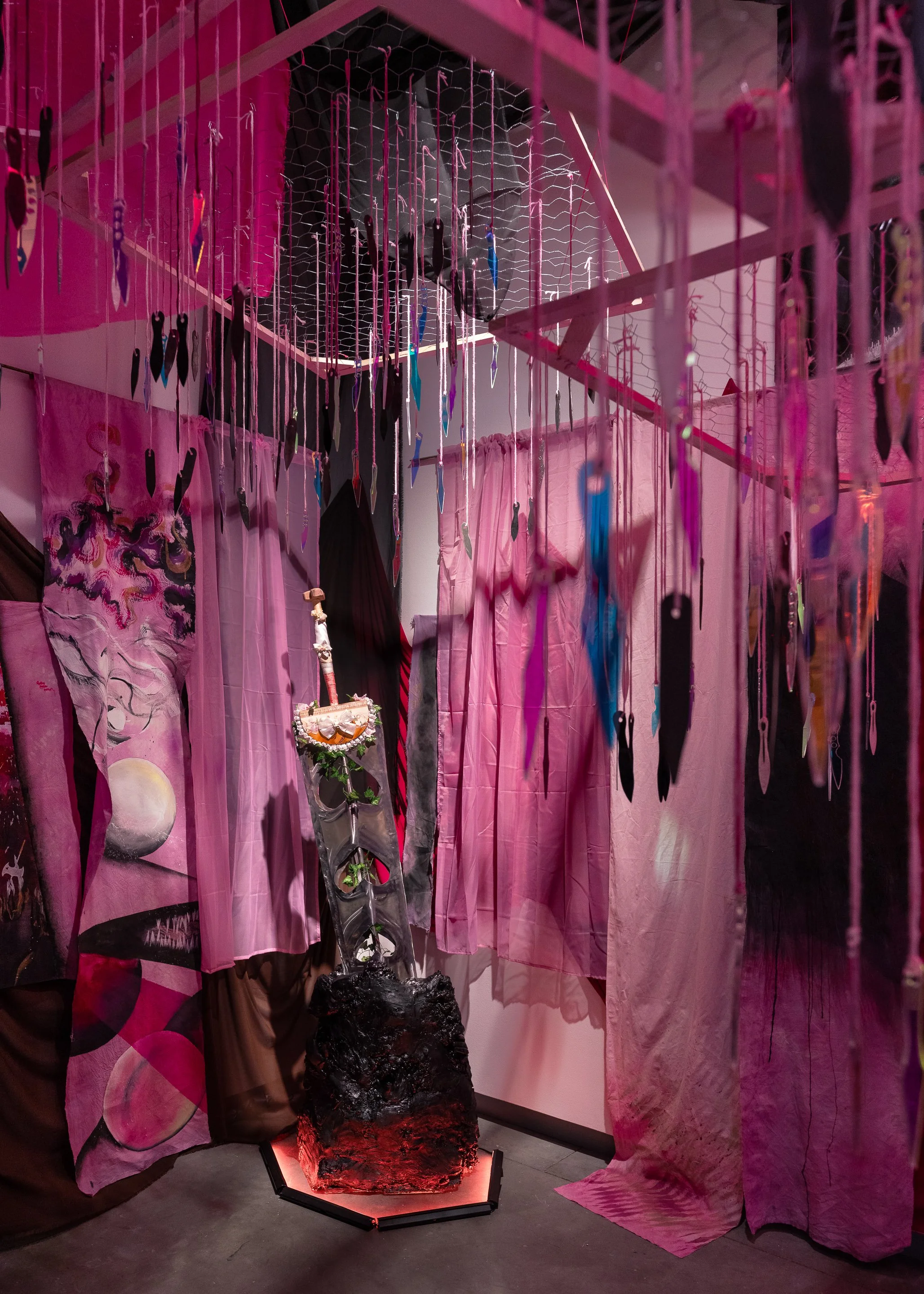
By analyzing speculative fiction and lived experiences, my thesis proposes alternative environments that center on care, agency, and joy. Through the creation of Selara, a fictional world designed as a sanctuary for BIPOC women, this project extends theoretical discussions into speculative practice, illustrating how reimagined environments can counteract real-world harm. Ultimately, this installation and its research argues that safe spaces must be intentionally crafted and continuously defended, not only as physical refugees but as radical affirmations of existence. In doing so, it envisions new possibilities for belonging and collective survival.
This installation titled, The Space that Holds Us: Built from Memory, Fear, and the Hope of Something Softer, invited viewers into a constructed world where speculative aesthetics meet urgent cultural memory. Suspended from gridded frames above, hundreds of handcrafted weapons—each one distinct in form and texture—hang like artifacts from an imagined future. They evoked a sense of ceremony and readiness, transforming the gallery into a hybrid space: part sanctuary/part armory.
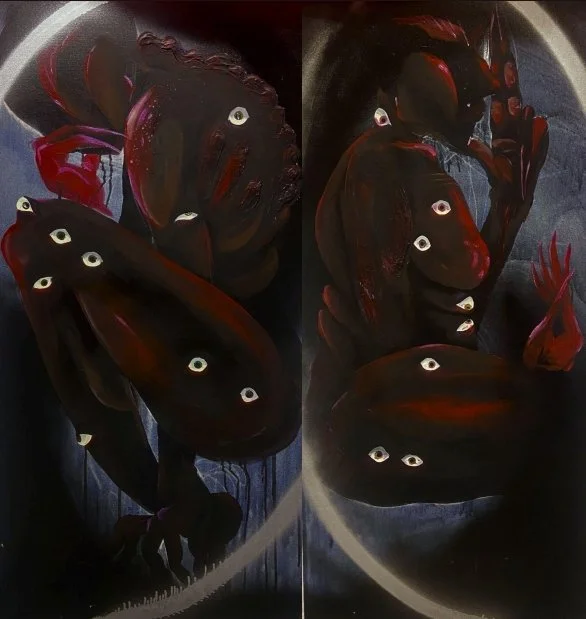
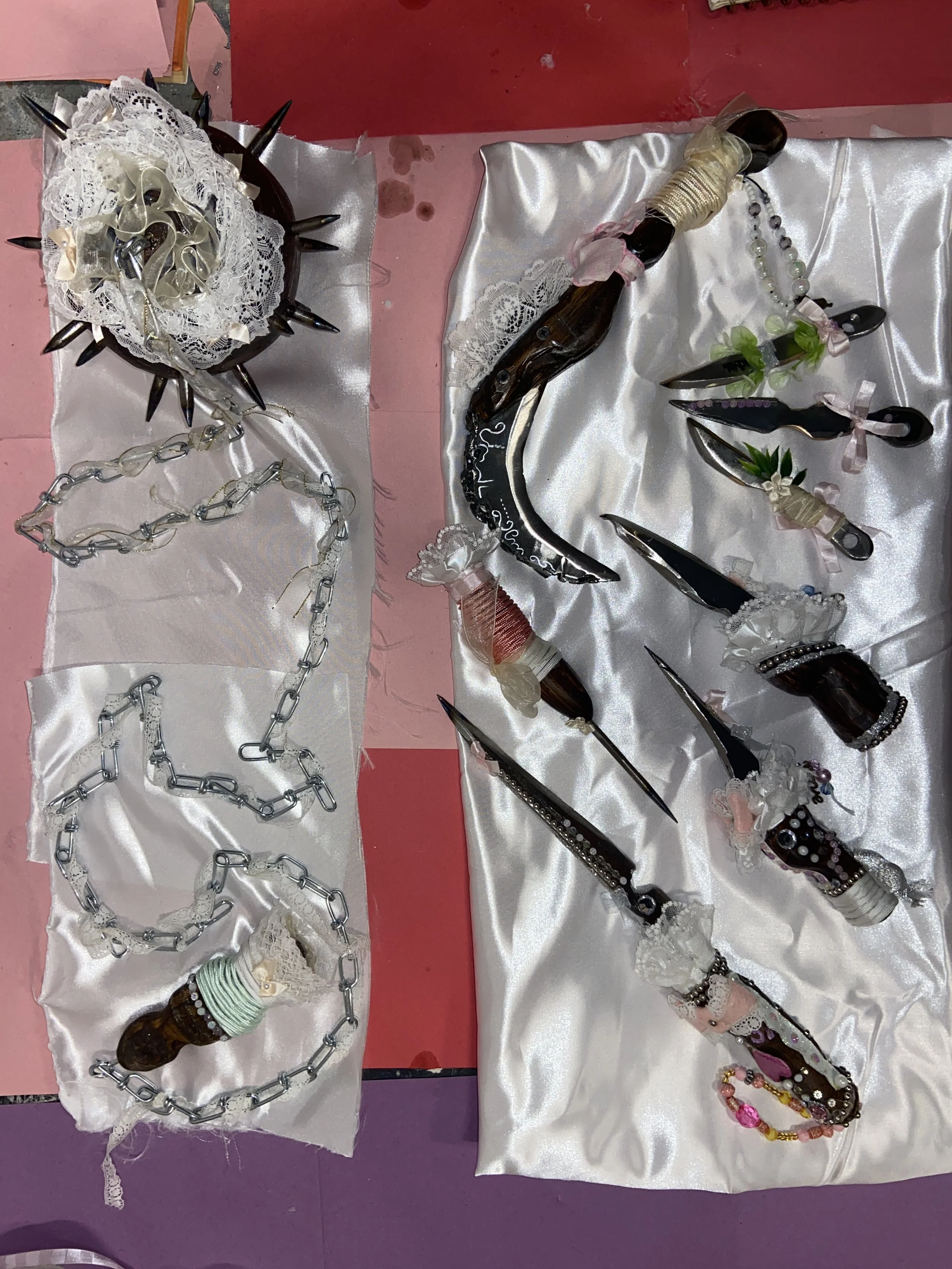
The weapons did not function as objects of violence. Instead, they served as avatars—representations of BIPOC women, embodied through material and metaphor. Each blade and point was a portrait: not in likeness, but in power, in presence.
Through an interplay of textiles, sculpture, and spatial installation, the work explored themes of hypervisibility, representation, and beauty all through the lens of Afrofuturism. I drew from both science fiction and ancestral technologies to imagine a future where survival is not just possible, but radiant—and resistance is both practical and deeply personal.
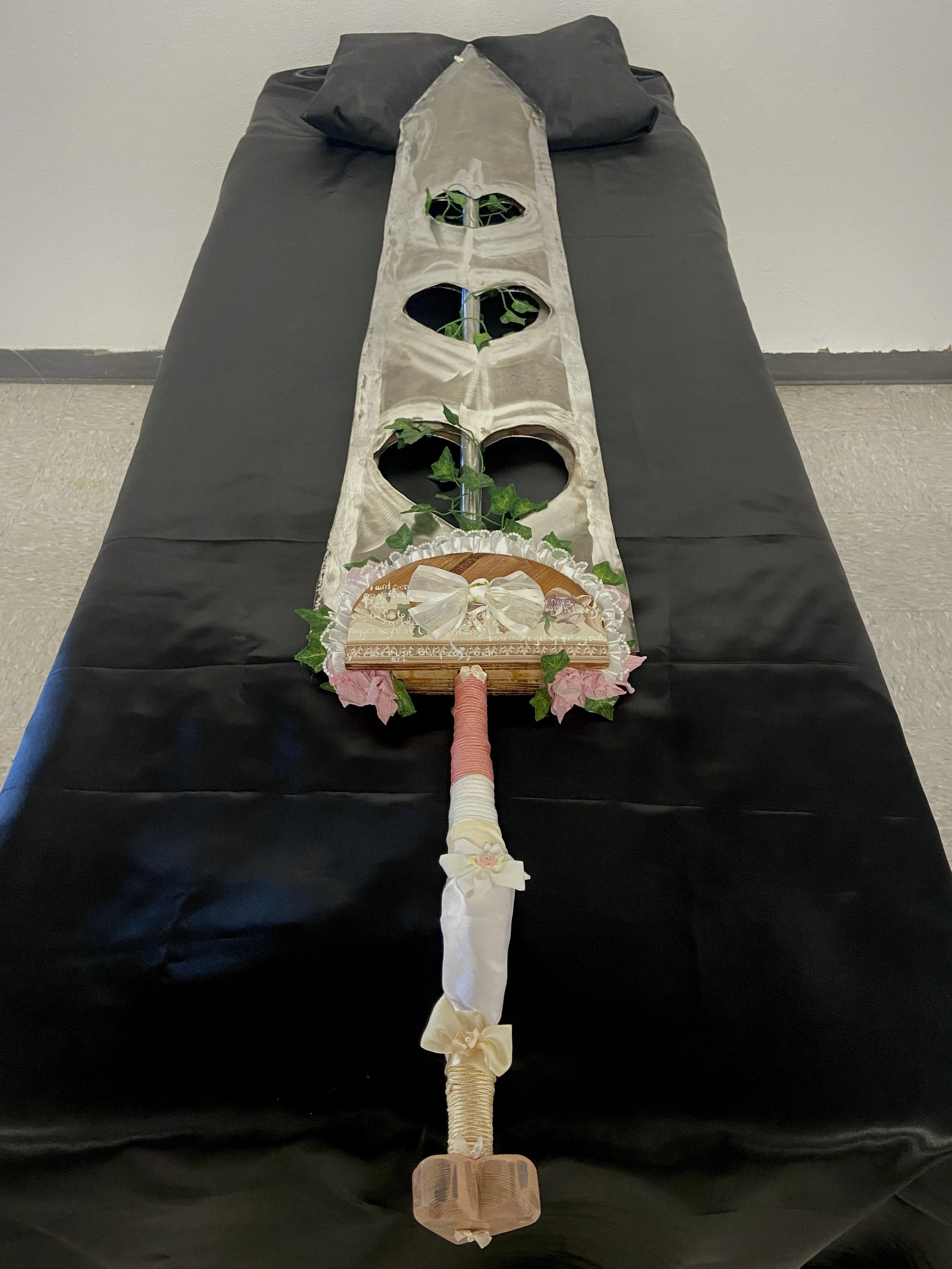
The assertion was further pushed by the piece Cynthia’s Proxy: A Blade That Won’t Be Pulled, which is a sword that stands six feet and seven inches tall from the tip of the blade to the end of the pommel. The sword was made by cutting and hammering flat sheet metal and welding it to a hollow two-inch pipe. The sheet metal has three hearts that were plasma cut out and then ground to be smooth. Most of the detail is concentrated on the cross guard and hilt. Two semi-circles of wood sandwich the base of the blade, with floral wallpaper laminating the flat surface. All of the gaps surrounding the hilt are filled with pink paper flowers and artificial vines to insinuate the sword is alive, or at the very least, can support life. The finishing touches to the sword are song lyrics written in white paint on the wallpaper and two small bows on the tip of the blade. The song lyrics are from contemporary rap songs including Kendrick Lamar’s “Not Like Us,” JID’s “Dance Now,” and Rico Nasty’s “Smack a Bitch.” The lyrics on the hilt serve as a message to the viewer, suggesting the sword has the autonomy to threaten anyone who gets too close.
The design is an interpolation of the Dragon Slayer from Kentaro Miura’s manga series, Berserk. In the manga, the main character, Guts, is the only person who can wield the Dragon Slayer because of its immense weight. Through a long life of hardships—assault, trafficking, being sacrificed by his only friend—Guts has been hardened into a reluctant warrior. He constantly was forced to face impossible challenges but must overcome them, because if he doesn't then the story ends and he dies. It is resilience after unending suffering that allows him to keep moving forward.
Cynthia’s Proxy is a self-portrait. In a larger practice of making weapons as avatars for real people, there needed to be some kind of baseline, or rubric. By using myself as a template, I was able to hone on the traits that really mattered in the weapon’s design. By using the Dragon Slayer as inspiration, resilience through hardship was already baked into the overall meaning. This, coupled with my personal history of necessary resilience, made for a conceptually heavy piece that was mirrored in its physical weight. The sword is impossible to wield, and it needs to be supported to stand. The rock it stands in is a direct reference to Excalibur as the sword in the stone calls to a past where colonization was seen as a right and white men could take as they please. By not only asserting that the safest way for BIPOC women to exist is as weapons, but also that I am Excalibur and that no one can wield me.
The space is framed as both a stage and a sanctum. Lighting is subdued but intentional—spotlights highlight the suspended forms, casting long, shifting shadows that ripple across the gallery walls and floor. The weapons, though inanimate, seem to exist in mid-motion as if they might activate at any moment. There is no single focal point; rather, the viewer is encouraged to move through and around the installation, experiencing it from multiple angles.
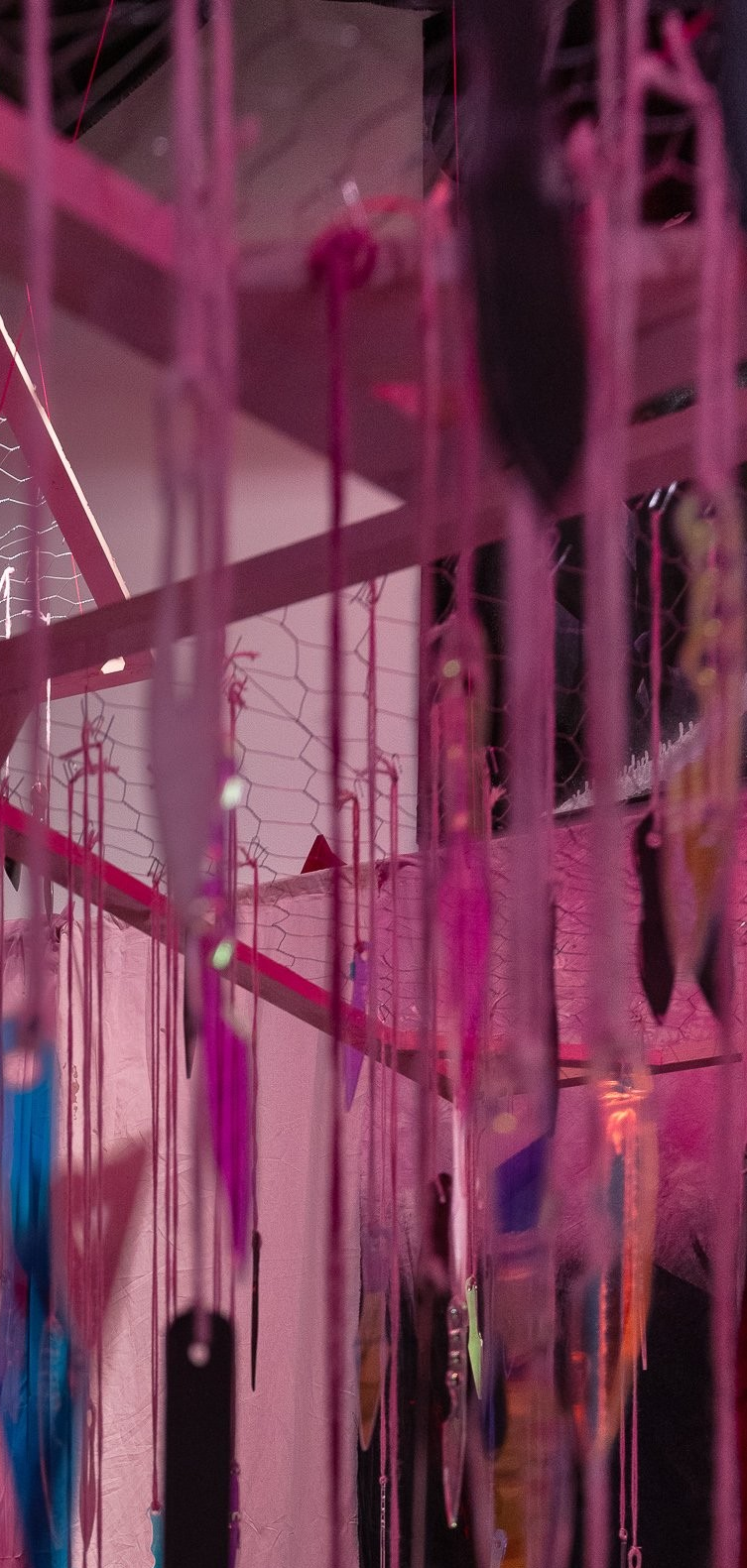
The atmosphere invites both reverence and inquiry. Visitors are not merely looking at objects but navigating within a constructed world—one where the rules of engagement are speculative, symbolic, and charged with cultural memory. The absence of human figures is notable; instead, the weapons stand in as surrogates, each one a proxy for presence, for identity, for defense, for power.
Images in order
1. The Space that Holds Us: Built from Memory, Fear, and the Hope of Something Softer, multimedia installation, photographed by Joel Tsui Courtesy of the MECA&D ICA, 2025
2. Cynthia Nathan, Aggressive and Resilient; 2024. Acrylic paint, glitter glue, spray paint, mirror on canvas. 24 x 48 in.
3. Cynthia’s Proxy, 2024. Steel, Wood, Wallpaper Roll, Tissue Paper, Fake Flowers and Leaves, White Acrylic Paint, Pink Acrylic Paint, Ribbon, Bows, Polyester Cord, Tabletop, Sawhorses, Sleeping Bag, Pillow, Outdoor Fabric. 6.7 x 1 ft.
4. proxy weapons, in progress image, 2024
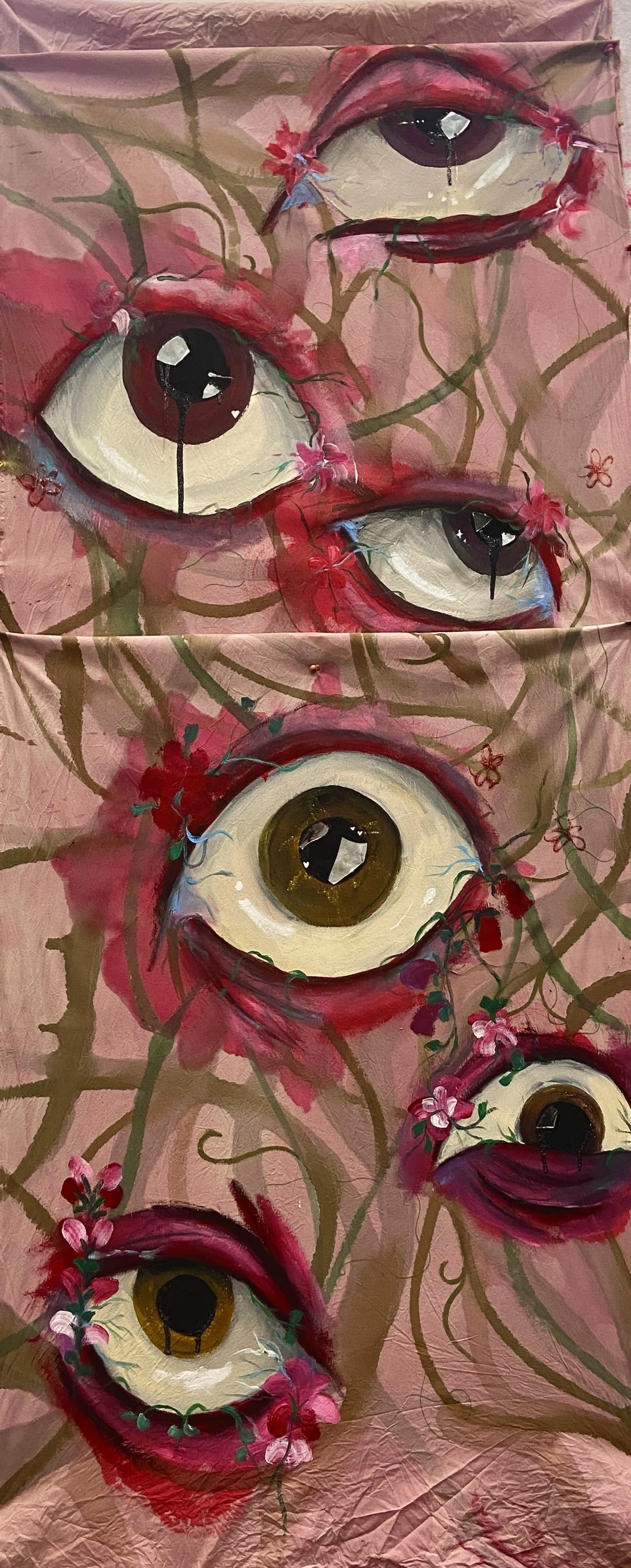
5. Watched; 2024. Acrylic paint, glitter glue, mirror on dyed muslin. 9 x 2 ft.
6. The Space that Holds Us: Built from Memory, Fear, and the Hope of Something Softer, installation detail, photgraphed by Midori Morrow, 2025
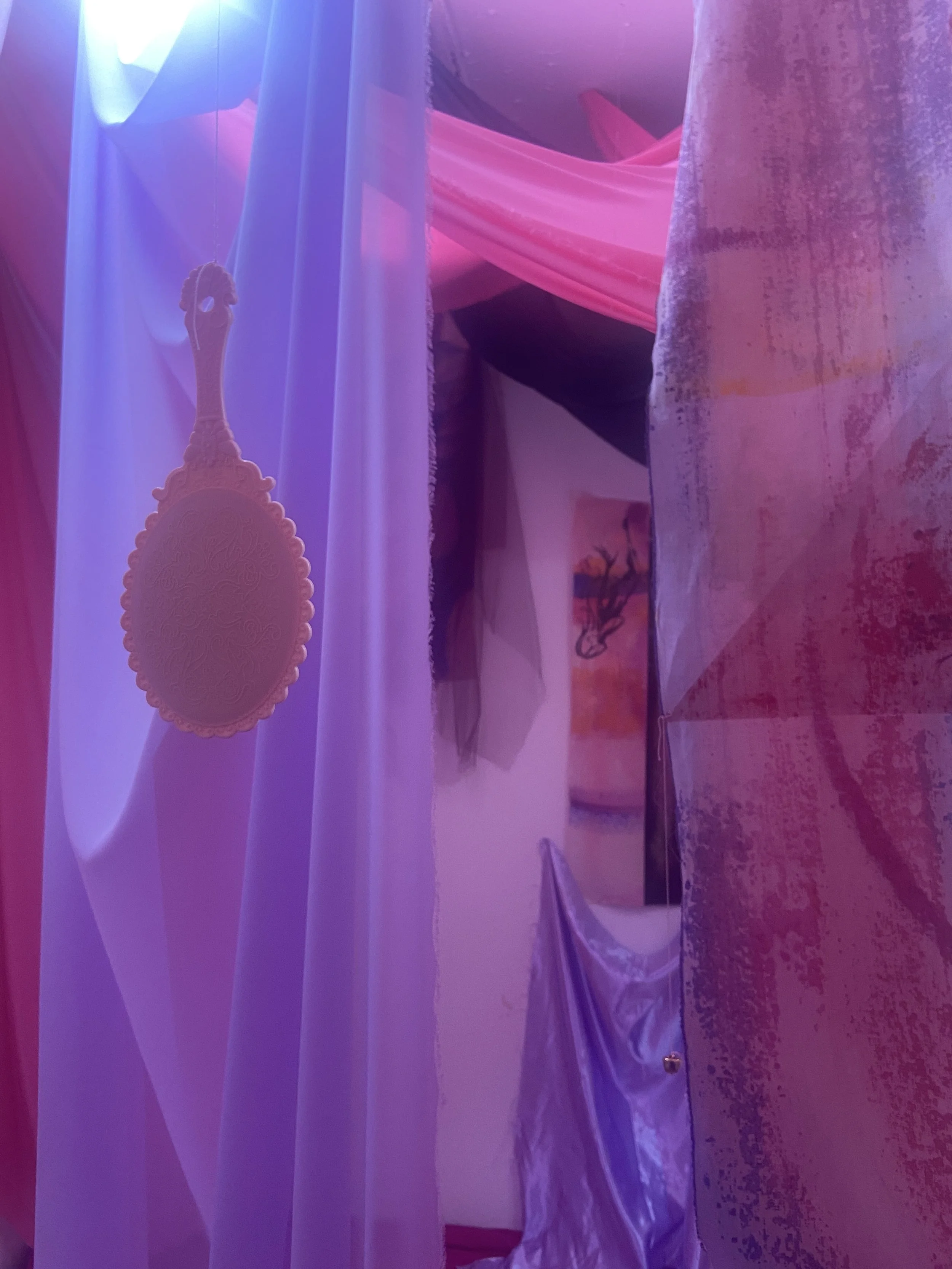
7. Stepping into Selara, 2024 (detail), Installation: Acrylic Paint on Muslin, Chiffon Fabric, Felt, Glitter, Perfume, Brass Bells, Pink Twine, Vanity Hand Mirrors.
QUOTE AS:
Cynthia Nathan. The Space that Holds Us: Built from Memory, Fear, and the Hope of Something Softer. The Living Commons Collective Magazine. N.4, July 2026. p. 173-180
