Assentamento, Bodies, and Memory: Rosana Paulino’s Work as a Tool for Understanding Memory Not Only as Scars but as Resistance Inscribed in Black and Female Bodies
by
Denise braz
Introduction
This article examines Rosana Paulino’s Assentamento and Embroidery Hoops (2018) as visual archives of Black memory, focusing on how Black and female bodies register the enduring scars of colonial violence while simultaneously enacting strategies of survival, healing, and re-signification. I argue that Paulino’s use of assentamento1 exceeds its literal translation as “settlement” and instead operates as a Black epistemological and aesthetic strategy through which memory, ancestry, and embodied history are preserved and activated in the present.
Drawing on Lorraine Leu’s (2023) theorization of assentamento as a form of insubordinate geography, this article approaches Paulino’s work as a site where Black memory is not merely represented but materially produced. Paulino’s visual language repositions the Black female body from an object of colonial violence to a living archive – one that bears historical trauma while sustaining collective futures. In this sense, assentamento functions as both a spiritual and political practice: it consecrates space, grounds memory, and enables Black bodies to endure and reimagine themselves beyond colonial frameworks of erasure.
Methodologically, the article is guided by Tina M. Campt’s (2021) notion of the Black Gaze, which calls for engaging images not only through sight but through listening, feeling, and attunement to their affective frequencies. Rather than asking what Paulino’s images represent, I ask how they move, unsettle, and demand ethical engagement. This approach allows for a reading of Paulino’s work that foregrounds sensorial experience while remaining grounded in critical analysis.
The article also draws on Black feminist scholarship that conceptualizes the body as memory and archive (Hortense Spillers 1987, Diana Ramey Berry 2017, Grada Kilomba 2020), as well as on reflections about non-Western temporalities of memory (Octavia Butler 2018, Toni Morrison 1995). Within this framework, memory is not linear or contained in the past; it circulates through bodies, scars, gestures, and rituals. While the article adopts an autoethnographic perspective, personal experience is mobilized here not as an individualized narrative but as an analytical entry point that resonates with collective Black diasporic histories.
By centering Rosana Paulino’s work, this article contributes to Black feminist art criticism by articulating assentamento as a method for understanding how Black women’s bodies function simultaneously as sites of historical inscription and as living commons for the production of alternative futures. Paulino’s art, I argue, invites us to engage Black memory not as static trauma, but as a dynamic, embodied practice of resistance, care, and becoming.
What is assentamento? Where does this word come from?
From a religious perspective, the assentamento (settlement) is the initiation ritual for participants of Afro-Brazilian religions known as Candomblé –and Umbanda– in Brazil (Verger 1983, Sansi 2009, Goldman 1984). Members of these religions also often perform assentamento as part of what they call preceitos, a moment for closing and opening evolutionary cycles in each member's spiritual journey. Based on testimonies from friends who participate in one of the branches of Candomblé called Ketu, I observe that an assentamento can be performed differently in Candomblé (Goldman 1984 e Sansi 2011). However, in both religions, the assentamento is the first act that marks one's entry into their religious family. In other words, it is through the settlement that participants integrate into their ancestral family lineage within Candomblé, as they consecrate themselves to the orixá recognized as the owner of their head—sometimes more than one orixá.
The first settlement is for Orí, which in Yoruba means "head." This assentamento consists of small symbolic objects, primarily in light colors, conveying the ideas of lightness, peace, control, balance, illumination, and life. Among these objects, there will always be a small pot of water, regardless of which orixá is settled. Water is an essential element in Ketu lineage assentamento rituals. For an initiation assentamento, the pai or mãe de santo (spiritual leader) must first consult Ifá, the Yoruba divination system using búzios (cowrie shells), in which Exu—the orixá of pathways and communication—will reveal to the participant their head orixá (or multiple orixás). During the process of building the assentamento, the participant must gather objects that represent all the qualities and characteristics of their orixá. In Ketu Candomblé, the orixá is seen as an ancestor of the individual, meaning someone who preceded them in their genealogical tree. According to the religion, the orixás once had human forms, lived on Earth, built their families, and actively participated in their communities.
I argue that the settlement is a fluid connection—a movement of renewal and care for Black life in Latin America. Thus, the assentamento is both the rebirth and the maintenance of Black lives on the new continent through a continuous, fluid, and organic process of (re)living, (re)creating, and connecting transnational and transatlantic memories. The assentamento contributes to enabling the Black body to transcend the trauma of rupture from the maternal territory and to resist multiple forms of epistemicide –cultural, linguistic, religious, intellectual, and any other type of individual and collective knowledge suppression. The African territory remains the place of longing and ancestral memory, while the Afro-American territory becomes the space of occupation, (re)identification, reconnection, and the formation of new Black territorialities, such as quilombos and favelas.
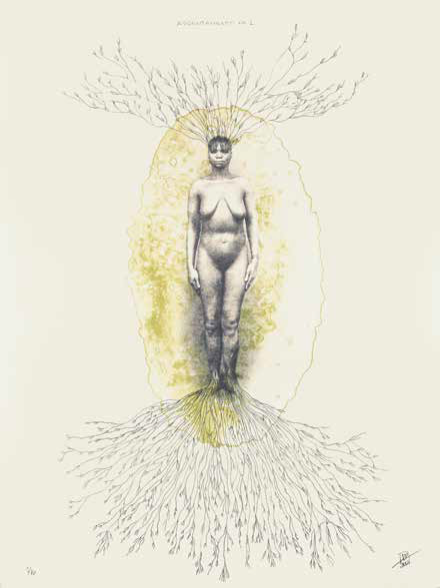
Assentamento. Rosana Paulino, 2018
Paulino’s Assentamento series deepens this engagement by explicitly mobilizing Afro-Brazilian religious cosmologies. The fragmented and reassembled female body –stitched together in asymmetrical ways, bleeding from the heart and womb –invokes the ritual logic of assentamento as practiced in Candomblé. Here, the body is consecrated ground. Blood functions not only as a marker of pain but as a sign of vitality, ancestry, and continuity. In this visual grammar, the Black female body becomes both altar and archive, a site where the sacred and the historical intersect.
This religious dimension is crucial for understanding how Paulino reframes trauma. In Candomblé, assentamento is a ritual of grounding and alignment, linking the individual body to ancestral forces and collective memory. Paulino translates this logic into visual form, suggesting that Black memory does not reside solely in the past but is continually reactivated through embodied practices of care, ritual, and remembrance. The rooted bodies in Assentamento, bleeding into the earth, signal not immobilization but belonging—an insistence on presence in a world structured by anti-Blackness.
While this article adopts an autoethnographic lens, personal embodied responses function here as analytical resonance rather than narrative center. The affective intensity elicited by Paulino’s work – moments of physical discomfort, emotional saturation, or sensory disorientation – reflects the capacity of these images to activate collective Black memory. Such responses are not individual anomalies but indicators of how Paulino’s work operates as a commons of feeling, where private sensation intersects with shared historical experience.
Assentamento as a Living Commons: Black Memory, Care, and Radical Futures
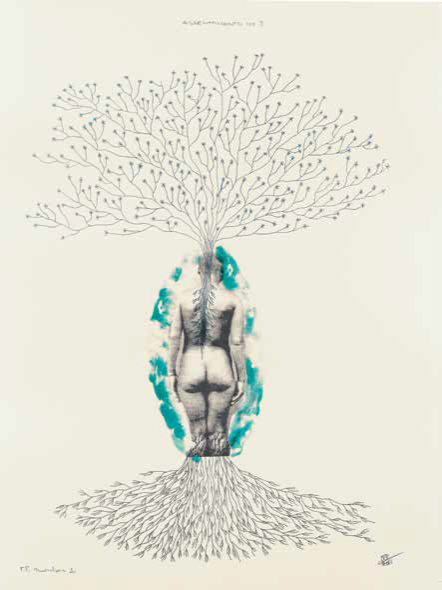
Assentamento. Rosana Paulino, 2018
Paulino’s Assentamento does not merely reassemble fragmented bodies; it proposes a grammar for living otherwise. By grounding Black female bodies in ritual, ancestry, and material memory, her work articulates what can be understood as a living commons – a shared space where memory, care, and survival are collectively produced rather than privately owned. In this sense, assentamento operates beyond metaphor: it is a practice through which Black life insists on continuity despite historical regimes of dispossession.
Within Black diasporic histories, the commons has often emerged not as land legally recognized by the state, but as relational infrastructures sustained through bodies, rituals, and everyday acts of care. Paulino’s visual language captures this dynamic by transforming the Black female body into a site of convergence between history and futurity. The stitched flesh, the exposed organs, and the rooted bodies signal not only wounds but also connective tissue – what holds communities together across time.
This articulation of assentamento resonates with Black radical traditions that understand survival itself as a political project. Rather than imagining the future as a rupture from the past, Paulino’s work insists on continuity: futures are built from what has been carried, endured, and reworked. Memory, here, is not an obstacle to futurity but its condition of possibility.
Importantly, the commons Paulino evokes is not abstract. It is gendered, embodied, and situated. Black women appear as central figures in sustaining life amid anti-Black infrastructures, not as symbols of suffering but as agents of continuity. Through this lens, assentamento becomes a method for imagining futures grounded in care, relationality, and ancestral accountability – futures that refuse the erasures demanded by colonial temporalities.
Sensing Futures: Assentamento, the Black Gaze, and Radical Imagination
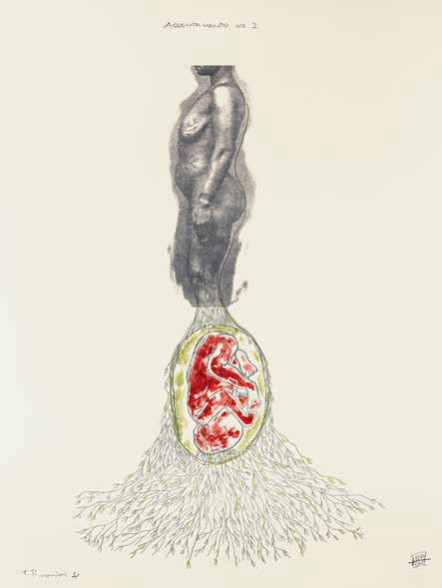
Assentamento. Rosana Paulino, 2018
Following Tina M. Campt’s call to listen to images, Paulino’s work demands an engagement that exceeds interpretation. The affective charge of Assentamento – its capacity to provoke discomfort, grief, and recognition – functions as a mode of political education. These images train the senses to attune to Black life not as spectacle, but as frequency, vibration, and persistence.
This sensorial engagement is central to Black radical explorations of the future. Rather than projecting futurity as technological progress or temporal escape, Paulino’s work insists on sensing futures already in formation. The bleeding heart, the rooted body, and the stitched flesh are not endpoints; they are thresholds. They mark sites where pain and care coexist, where survival becomes a form of imagination.
In this sense, the Black gaze cultivated through Paulino’s work is not merely oppositional; it is generative. It produces ways of seeing – and feeling – that refuse colonial optics of domination. By returning the gaze, Black bodies reclaim their capacity to define value, memory, and possibility on their own terms (Campt`s 2021).
Assentamento, therefore, functions as a pedagogy of futurity. It teaches that imagining otherwise requires staying with the wound without being consumed by it, honoring ancestry without immobilization, and cultivating collective practices of care. These futures are not utopian abstractions; they are grounded in embodied knowledge forged in struggle.
Conclusion
This article has argued that Rosana Paulino’s Assentamento articulates a Black epistemological strategy through which memory, body, and futurity are inseparably linked. By mobilizing Afro-Brazilian religious cosmologies, Black feminist theory, and visual practices, Paulino transforms the Black female body into a living archive and a commons of survival.
Instead of than framing trauma as an endpoint, Paulino’s work insists on memory as a generative force – one that enables Black communities to imagine and sustain alternative futures. Through assentamento, memory becomes practice, care becomes politics, and the body becomes a site of knowledge production.
In dialogue with Black radical traditions, this article positions Assentamento as an invitation to sense futures otherwise: futures grounded in ancestry, relationality, and collective endurance. At a moment when Black life continues to be threatened by regimes of dispossession and death, Paulino’s work reminds us that survival itself remains a radical act – and that the commons of Black memory is one of its most enduring foundations.
Notes
1The term “assentamento” is retained in Portuguese because, according to Lorraine Leu, it signifies not simply “settlement” in a colonial sense, but a conceptual space of Black knowledge production, memory preservation, and the reconfiguration of Black life beyond Western territorial logics. "Settlement: Rosana Paulino and Black Women Writters Lived Experiences and Ancestralities." Smith, Christen and Lorraine Leu. Black Feminist Constellations: Dialogue and Translation across the Americas. Austin: University of Texas Press, 2023. 334
Works Cited
Berry, Diana Ramey. The Price for Their Pound of the Flesh: the value of the enslaved, from womb to grave in the building of the Nation . Boston: Beacon Press, 2017.
Butler`s, Octavia. Kindred: A Graphic Novel Adaptation by Damian Duff and John Jennings. first edition 1979. Abrams, 2018.
Campt`s, Tina M. A Black Gaze: artists changing how we see . The MIT Press , 2021.
—. Listening to Images. Duke University Press, 2017.
Goldman, Marcio. A possessão e a construção ritual da pessoa no candomblé. Dissertação de Mestrado, Programa de Antropologia. Rio de Janeiro : UFRJ, 1984.
Kilomba, Grada. Memories of the Plantation: episodes of daily racism. Trans. Jess Oliveira. 1. Rio de Janeiro: Cobogó, 2019.
Leu, Lorraine. "Settlement: Rosana Paulino and Black Women Writters Lived Experiences and Ancestralities." Smith, Christen and Lorraine Leu. Black Feminist Constellations: Dialogue and Translation across the Americas. Austin: University of Texas Press, 2023. 334.
Morrison, Toni. "The Site of Memory." in Inventing the Truth: The Art and Craft of Memoir 2 (1995): 83-102.
Paulino, Rosana. A Costura da Memória. Estação Pinoteca - Valeska Soares : entrementes / curadoria Júlia Rebouças. A Costura da Memória. São Paulo, 2018.
Rabelo, Mirian C.M. Enredos, Feituras e Modos de Cuidado: dimensões da vida e da convivência no candomblé. Salvador: Edufba, 2014.
Sansi, Roger. "Fazer o santo’: dom, iniciação e historicidade nas religiões afro-brasileiras." An[alise Social XLIV (2009): 139- 160.
—. "Images and persons in candomblé." Material Religions (2011): 374-393.
Spillers, Hortense J. "Mama's Baby, Papa's Maybe." An American Grammar Book. Source: Diacritics, Vol. 17, No. 2, Culture and Countermemory: The "American" Connection (1987): 64-81. The Johns Hopkins University Press.
Verger, Pierre. "A sociedade egbe òrun dos Abikü, as crianças nascem para morrer várias vezes." (1983): 138-160.
QUOTE AS:
Denise Braz. Assentamento, bodies and memories: Rosana Paulino’s work as a tool for understanding memory not only as scars but as resistance inscribed in Black and female bodies. The Living Commons Collective Magazine. N.4, July 2026. p. 18-28
