anticolonial futures
The Living Commons Collective Magazine, n. 5, July 2026
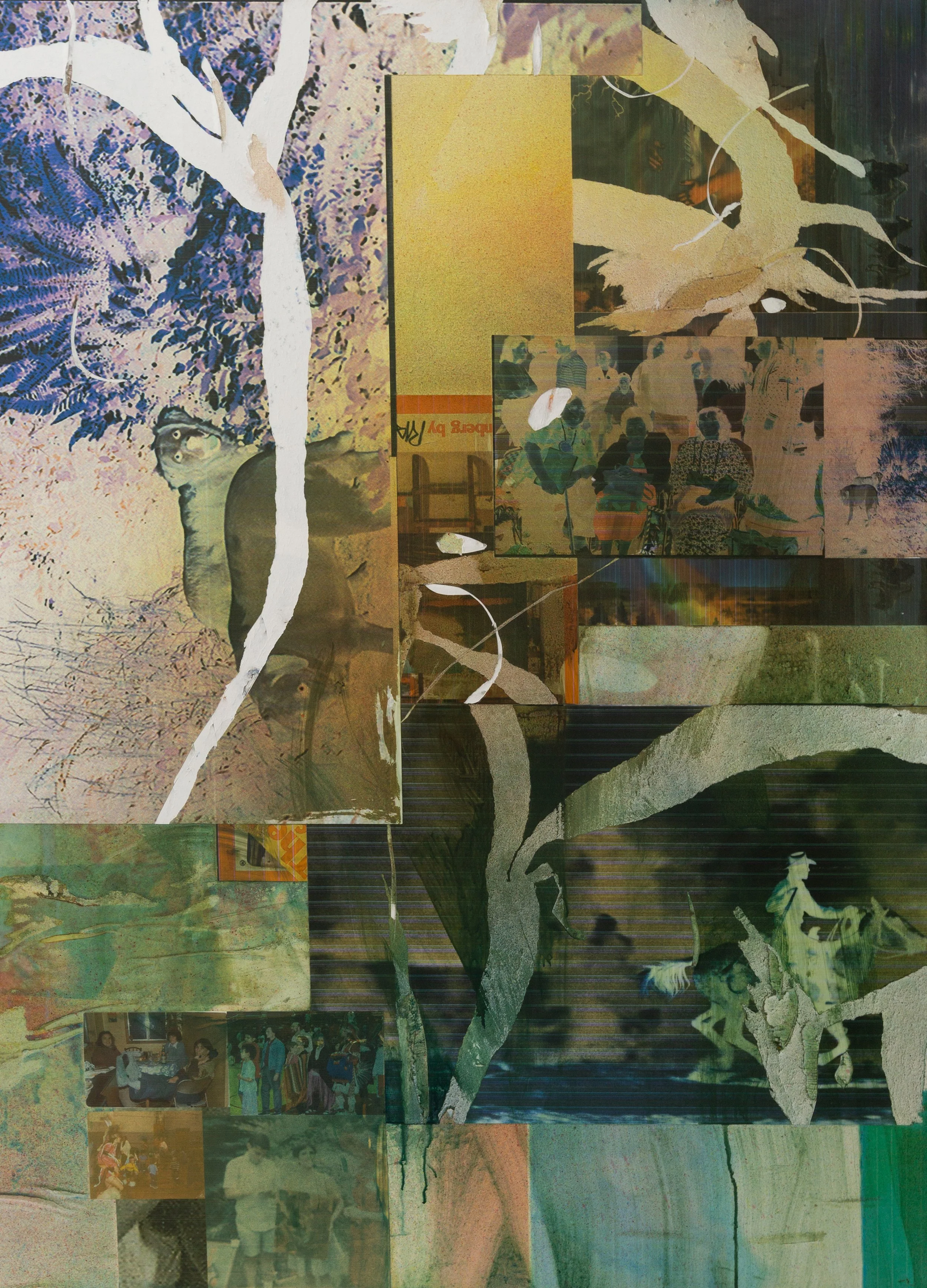
Detail of Channel Surf 2, 2026, Acrylic and collage on canvas, 46 x 70”
In many ways, whether one looks at social or environmental conditions, the world we have come to know over the past five centuries is coming to an end. Kicking and screaming, trying to hold on to its structures (namely, capital, colonial, and racial violence) as it dies out. For the indigenous and black populations of the Americas, many worlds have been ended and, in the face of constant total violence, they’ve articulated (and continue to) larger and minor practices of auto-defense and collective self-determination. There is a verb tense in the Portuguese language, the more-than-perfect past (pretérito mais que perfeito), which captures the place of enunciation consistent with such global-historical trajectory. This tense refers to an action happened in the far away past before something else that also happened in the past, that is, the more-than-perfect refers to anything and everything that preceded anything and everything that happened later that then precedes something that happens after, and so on, it appropriately describes a mode of thinking (of sensing + imagining + grasping) that does not assume an efficacy and permanency (in time), that is, a thinking and knowing that does not rest on something like a subject or an efficient cause that will remain the same at the beginning and end of the action or experience. By foregrounding the imagination instead of the understanding, which is the usual site of considerations of subjugation and political interventions of marginalized populations, this special issue wishes to create opportunities for exploring questions that reconsider the relationship between criticality, creativity, and sensibility. Questions that challenge the presumption of disinterestedness in considerations of the aesthetic. Instead, by acknowledging its centrality in the constitution of the liberal political subject in the 19th century, they also signal that the imagination — considered here in terms of the capacity to create — must be both object of critical engagement and also as holding force to be mobilized in any project for an other, better, that is a just world.
