The Fugitive Tense: Audre Lorde and Assata Shakur in Abiayala
by
alex voisine
Once you have caught a glimpse of freedom or
experienced a bit of self-determination,
you can’t go back to old routines established under a racist, capitalist regime. — Frances Beal, Double Jeopardy
Introduction
Though the life histories of Audre Lorde and Assata Shakur as documented in their autobiographies1 Zami: A New Spelling of my Name (1983) and Assata (1987) are oft-cited and tend to be sites of frequent critical academic engagement, there is less focus on the formative moments they spent in Abiayala2. Audre Lorde’s transnational activism has been relatively well-documented (Bolaki and Broeck), but the transformative four months she spent in Mexico in 1953 when she was eighteen is rarely taken up (Bolaki). Assata Shakur’s reflections on the early years of her exile in Cuba in the final chapter of her autobiography have similarly received little attention, despite Cuban filmmaker Gloria Rolando’s 1997 documentary Eyes of the Rainbow about Shakur’s ongoing exile. This may owe to the fact that in both books, these Abiayala sojourns occupy relatively little space (eight pages in Assata and roughly twenty-three pages in Zami). Nevertheless, what these fugitive etchings lack in page numbers they more than make up for in their capacity to imagine what Yomaira Figueroa-Vazquez calls “worlds/otherwise,” (2) that re-map futurity away from empire.
Assata and Zami also offer formal interventions into exilic and travel writing. Unlike the long history in Abiayala of masculinist, exoticizing and extractive travel literatures written by (male) global northerners that reduce their spaces of sojourn to domitable topographies of extraction and desire (Fornoff 18), Lorde and Shakur see hope and astonishment in their surroundings; idealistic but not naïve, they see a future where others saw a retrograde, uncivilized past. In an era of mass violence and gendered violence in Mexico and amidst the accumulated effects of embargoes/blockades, the false promises of post-racialism (Clealand), and censorship in Cuba, Zami and Assata map, into the future, the coordinates of a mobile, transnational, and fugitive commons.
Foregrounding transnational, Black, feminist, and queer scholars like Hortense Spillers, Christina Sharpe, Marquis Bey, Fred Moten, and Yomaira Figueroa-Vazquez, I introduce the fugitive tense as a way of marking Shakur and Lorde’s grammatico-temporal interventions in their books: sprouting from a palimpsestic past, rooted in the wake of transnational anti-Black and colonial violence, holding the past close as an archive of grief and resistance (Sharpe), but always extending away from it, towards an unfolding future in an unsatisfying present. I find that their travel/exilic/migratory writing thus offers an intervention into how we understand, experience, and represent human mobility. As Black women exiles, writers, and activists moving from the global North to the global South, Lorde and Shakur ultimately offer coordinates for solidary living that are relevant in our highly mobile and inequitable world, and especially in Abiayala. They urge us to think across geographies and across tenses—the preterit, the present, the future, etc.—as we imagine “worlds/otherwise” that flee from the oppressive worlds we inhabit, have inhabited, and will inhabit in the absence of resistance.
As I show in this essay’s conclusion, revisiting Lorde and Shakur is critical for contemporary hemispheric cultural studies. Abiayala has become a site for imagined futures by global Northern migrants that displace, gentrify, and colonize in the present: retirees have found more affordable living in so-called “expat” hubs like Cuenca, Ecuador (Hayes), cryptocurrency bros have been offered lower tax rates in Puerto Rico and unfettered investment opportunities in Central America, and young US Americans have elected for the cosmopolitanism of Mexico City and other locales in Mexico, where favorable currencies permit upper-middle-class lifestyles that could only be dreamed of in the metropole, all while the global landlord class generates new rent gaps that are rapidly gentrifying and displacing (Delgadillo; Lees et al.) Black US Americans in particular have opted out so markedly that a neologism—Blaxit—has been coined to refer to these “Black exits” from the racism and stress of US American “life” (Lordi). In Lorde and Shakur’s writing, Mexico and Cuba were places to breathe, create, imagine, and rest. But do both locals and foreigners have access to the hope and futurity that so fundamentally revived Shakur and Lorde? What solidarities can arrivants—fugitives, exiles, expats—extend to and receive from their hosts?
The Fugitive Tense
You never realize how psychologically sick the U.S. is from this point of view until you live in a foreign country.” -Willard Motley3, cited in (Schreiber 139)
In what follows, I argue for a (re)turn to fugitivity to account for the ongoing need and political utility of leaving oppressive spaces, while also sitting with the complexity of what happens upon arrival to a new space. In my reading of Lorde and Shakur’s work, I am most interested in how their fugitive writing acts radically on notions of time or duration. Following Hortense Spillers, Christina Sharpe, and others who consider grammar as a site that both indexes and resists oppression, I consider the grammatical valences of fugitivity, offering it as a tense, a way of activating verbs across multiple temporalities and acting on writing in a formal sense. A tense, in its purely grammatical sense, is “a distinction of form in a verb to express distinctions of time or duration of the action or state it denotes,” or “a set of inflectional forms of a verb that expresses distinctions of time” (Merriam Webster.) A tense operates on verbs to show when and for how long they act. A tense may indicate the past, the present, the future, the conditional, etc. Tenses are also capable of operating beyond one temporality, offering rhizomatic modes of thinking about time: in Portuguese the more-than-perfect past (pretérito mais que perfeito) is used for any and all actions that preceded any other action, leading to a “mode of thinking that does not assume an efficacy, a permanency (in time).” The subjunctive mood—commonly used in Spanish, where it requires distinct and complex verb conjugations—is a way of “bringing the future into the present,” helping us to “investigate how we can work with potentiality in the present as a means to alleviate concerns with change4” (Fornoff, Wolf-Meyer 5). Aymara, spoken mostly in what is now Perú and Bolivia, has tenses that include a present potential—which indicates the possibility of an event in the near future—and a past potential—which indicates an action that could have, but failed to take place in the past. For Silva Rivera Cusicanqui, this has led to a distinct temporal consciousness wherein the “contemporary experience commits us to the present—aka pacha—which in turn contains within it the seeds of the future that emerge from the depths of the past” (Rivera Cusicanqui 96). In short, how we think of, practice, and imagine tenses as we construct, write, and perform languages impacts how we understand the temporality of action.
A fugitive tense, of course, does not exist in conventional grammars across languages. However, as I read Lorde and Shakur’s narratives of escape and resettlement in Abiayala, I identify a distinct relationship with time and space through language. It is as if by migrating in the way that they did—to escape persecution, racism, and gendered and sexual oppression in the United States—they developed a more complex grammar for the critique of existing worlds and the building of worlds/otherwise. In other words, beyond simply an action, fugitivity acts on actions as a tense does to verbs: it affects how things are done and how we conceive of time. Therefore, I propose to think about fugitivity as a tense, to consider what it might mean to “write” or “travel” or “think” in the fugitive tense: writing, traveling, thinking in the fugitive tense is neither past preterit nor present indicative nor past perfect nor future, but an insurgent, transtemporal otherwise, that avoids colonial and racialized capture at the same time that it indexes their histories and acts to move away from them in an unfolding future. As Assata Shakur and Audre Lorde show us as they write, travel, and interact in the fugitive tense, this means the carrying of the colonial histories of multiple geographies, acting against their reproduction in the present, wherever you may be, and building a collective future “surrounding democracy’s false image” (Moten and Harney 19).
The choice to interpret Lorde and Shakur’s migrations grammatically draws on a long tradition of Black feminist thinking that understands gender, race, and power at the level of language. In her 1984 essay “Interstices: A Small Drama of Words,” Hortense Spillers argues that sexuality is a “term of power” that “belongs to the empowered” (201). Like many other verbs, nouns, adjectives and figures of speech, sexuality’s historical signification is coextensive with the placement of Black women into the “paradox of non-being,” in that space and “historical moment when language ceases to speak, the historical moment at which hierarchies of power simply run out of terms because the empowered meets in the black female the veritable nemesis of degree and difference” (200). This has also meant “dispossession as the loss of gender” (77) as Spillers lays out in her 1987 essay “Mama’s Baby, Papa’s Maybe: An American Grammar Book.” Denied gender, defined against the normative gendering of the empowered, cast ontologically as property, Blackness is meant to signify non-humanness and ahistoricity even so far down as at the level of grammar (Spiller, “Mama’s Baby”; Wynter; Ferreira da Silva).
For Christina Sharpe, one of the “terrible gifts” of the hold or the wake is the anagrammatical, a state, a becoming, in which “grammatical gender falls away and new meanings proliferate…blackness anew, blackness as a/temporal, in and out of place and time, putting pressure on meaning and that against which meaning is made” (76). Sharpe sees this anagrammatical position of “deep hurt,” of racial, material, and grammatical violence, as one of “deep knowledge” (27). Ungendering may indeed be “understood usefully as a refusal of an identity,” a fugitive movement away from structures of capture (Bey 56; Táíwò). In a similarly future-oriented telos, though placed in the position of “awaiting their verb,” (“Interstices,” 197) Spillers believes in the introduction of a “new semantic field/fold” for Black women that would “rupture violently the laws of American behavior that make such syntax possible” (“Mama’s Baby,” 79). This legacy of Black feminist thinking provokes me to wonder: what (ana)grammatical potentialities exist within fugitivity, in the contact zones of the “over there”? Before I turn to Shakur and Lorde’s writing, which help to answer this question, I want to briefly engage the writing on fugitivity to consider the solidarities, complexities, incommensurabilities, and erotics of the contact zones to which the fugitive flees.
Fugitivity in the Contact Zone
Fred Moten and Stefano Harney’s The Undercommons: Fugitive Planning and Black Study, remind us that “exuberantly metacritical hope has always exceeded every immediate circumstance in its incalculably varied everyday enactment of the fugitive art of social life” (73). Their theory of resistance—to the university, to the state and its histories of dispossession, to a future marked by the structures of capture—is socio-poetic and improvisational, an “aesthetically inspired practice” (Schulman 302). If there exists an epistemology of freedom in The Undercommons, it is “in the invention of escape, stealing away in the confines, in the form of a break” (51). Art that refuses to be captured, tied up, researched; that seeks out that minuscule space through which to squirm away into an elsewhere that is improvisationally devised; that sits around and plans in a timescale that is “out of joint.” Importantly for theorizing Shakur and Lorde’s fugitive movements is Moten and Harney’s theory of the state, statelessness, and borders, the latter of which “fail to cohere because the movement of things will not cohere” (94). In Stolen Life, Moten proffers the idea that the “value of African-American life” may well be its “example of life in statelessness, and not a supposedly triumphant emergence into citizenship” (211). For Moten and Harney, the sociopoetics of fugitivity is thus a refusal of citizenship in the ways the state articulates: tacit acceptance of its legitimacy; agreement to be classified in the ways it chooses to classify you; complicity in its imperative to settle, dispossess, participate. What Moten and Harney call “the homeless aneconomics of visiting” (63) is a theory of movement that breaks with the logic of movement-as-possession, of arriving in a new place and owning it materially or immaterially. In a similar gesture towards the genderqueerness of fugitivity that coincides with Moten and Harney’s (dis)avowals of identity-as-capture, Marquis Bey argues that the “fugitive spirit of un/gendering points primarily to a ‘place where being undone is simultaneously a space for new forms of becoming’” (60). This, for Bey, makes possible a beneath, an under-ground, a “sub”-jectivity, a fugitive move away from subjectivity when the “Subject” is always a construction against Blackness (Wynter).
But what happens when the movement to this below-space, or the surround, or, in general, the place to which the fugitive escapes is not just a theoretical space but, as was the case with Shakur and Lorde, involved real movements across real borders into geographies with real peoples, histories, and structures of capture? What does a rejection of the “triumphant emergence of citizenship” actually look like or feel like? What emergent “semantic fields/folds” appear within this improvisational space?
In her book Lose Your Mother, Saidiya Hartman helps to answer these questions by describing and theorizing the specificities of Black travel, exile, and migration, especially from the global North to the global South. While it addresses different geographies (US-Ghana) than Lorde and Shakur’s work, Lose Your Mother approaches transnational “contact zones5” from a Black feminist perspective, considering how “fugitive dreams” and “yearnings for freedom” across time and space clash with the realities of US empire. The “inchoate, fugitive elsewhere” envisioned by slaves and their descendants, actualized by some Black migrants and fugitives in the 19th and 20th centuries in places like Mexico (Baumgartner) Paris (Stovall), Liberia and Sierra Leone (Hartman), becomes, in the twenty-first century, a possible extension of US empire, producing insular foreign enclaves that reaffirm, to the local community, the outsiderness of the outsider. Hartman arrives at these insights through her lived experience of relocating to Ghana, a voyage beset by truncated expectations and reconciliations between her “foreignness” as perceived by Ghanaians and her own sense of affiliation with her space of sojourn as the descendant of slaves forcibly removed from Africa. In the contact zones of Ghana, Hartman confronts what it means to be an emissary (albeit, unwillingly) of US empire, an imposed citizenship that is both violent and advantageous. In search of community and a “reclaiming” of those “undone and obliterated in the making of human commodities” Hartman comes to realize that contact is much more complicated, much more dependent on things far out of her control: “You could never love the foreigner whose wealth required you to inveigle a handful of coins….I had fled to their world and the boys [of Ghana] yearned to escape to mine…After all, who else but a rich American could afford to travel so far to cry about her past? Looking at me, the boys wished their ancestors had been slaves” (89). Hartman’s writing, in this passage and many others, reminds us that, as Yomaira Figueroa Vazquez writes, “colonial intervention, revolutionary actions, dictatorial rule, and first-world corporate interests are manifested within the lives and imaginaries of post/colonial Afro-Atlantic subjects” (7). Those from the global North who wish to escape the alienation they feel in their imposed “homelands” must contend with the economic and political structures that follow them and that they arrive into: it is here that fugitivity—the constant stealing away from structures of domination—becomes an exceedingly important practice, in an era of increased mobility for some and complete immobility for others (Puar “A Transnational Critique”).
I now turn to Assata Shakur and Audre Lorde to show how their writing in the fugitive tense offers a glimpse of what Figueroa Vazquez calls “worlds/otherwise,” a not-yet-here, a utopic “backward glance that enacts a future vision” (Muñoz 4). In a fashion and form resembling Hartman, Shakur and Lorde slip into a multitemporal grammar against domination, conjuring through conjugation a syntax of wayward routes, a “decolonizing diaspora” (Figueroa Vazquez) in the fugitive tense.
To Hope in the Fugitive Tense: Assata Shakur in Cuba
Though I dedicate most of my analysis of Assata to Shakur’s time in Cuba, I will first remark on how Shakur was ungendered and made into a monster by the U.S. government and media in the 1960s and 1970s, which will help to explain how sexuality and (un)gendering lie at the core of her fugitive move to Cuba, but also how her monstrosity was, to borrow again from Marquis Bey, a “space for new forms of becoming” (60). Throughout her autobiography, Shakur reflects on the gendered nature of her construction as a threat to U.S. society. She writes: “I am a Black revolutionary woman, and because of this i have been charged with and accused of every alleged crime in which a woman was believed to have participated. The alleged crimes in which only men were supposedly involved, i have been accused of planning” (50). Even before her arrest, in the part of her autobiography that touches on her childhood, Shakur reflects on how Black women’s sexuality is always already under scrutiny: “Any Black woman, practically anywhere in amerika, can tell you about being approached, propositioned, and harassed by white men. Many consider all Black women potential prostitutes” (106).
Shakur is also aware of how her experience as a revolutionary Black woman magnifies her image to monstrous proportions. Upon being incarcerated for allegedly killing a New Jersey police officer, some of her fellow inmates describe how they were surprised at how unintimidating Shakur appeared after only seeing her image on television: “Everybody told me they thought i was bigger, blacker and uglier. When i asked people what they thought i looked like, they would describe someone six feet tall, two hundred pounds, and very dark and wild-looking…” However, Shakur, at the level of grammar, writes against this magnification and distortion of her subjectivity. Denoting herself with a lower-case i in her autobiography, Shakur plays with the grammar behind subjectivity, embracing what Bey calls the “sub-ject” (60), as she also plays with the idea of her own (un)gendered monstrosity, looking back on it retrospectively with humor and amusement.
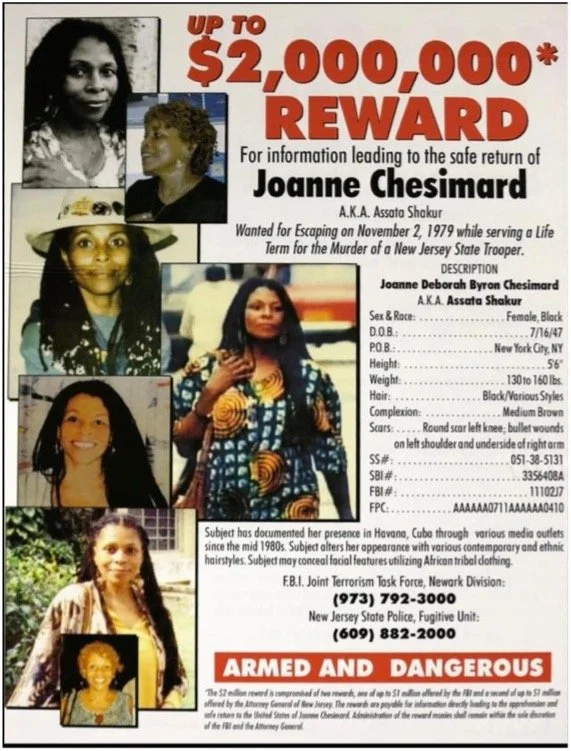
Figure 1: FBI Most Wanted Poster, Assata Shakur 1988
When she arrives in Cuba after escaping from prison in 1979, she is no longer an (un)gendered monstrosity. “Cuba is a country of hope,” (268) Shakur writes in the final pages of Assata, after recounting her story of radicalization, pursuit, capture, incarceration, love, family, and feminism. Reflecting on free medical and dental care, the free or reduced cost of cultural events, the construction of publicly-owned buildings, and “how much Cubans have accomplished in so short a time,” Assata is drawn into the Cuban Revolution even if she had already been partial to it. Her sense of hope and futurity is avowedly (geo)political, and she reflects on how “such a small island” has a “rich cultural life” and a tradition of generosity despite its being targeted by the U.S.:
Too many people in the u.s. support death and destruction without being aware of it…But in Cuba i could see the results of u.s. foreign policy: torture victims on crutches who came from other countries to Cuba for treatment, including Namibian children who had survived massacres, and evidence of the vicious aggression the u.s. government had committed against Cuba, including sabotage…I wondered how all those people in the states who tried to sound tough, saying that the u.s. should go in here, bomb there, take over this, attack that, would feel if they knew they were indirectly responsible for babies being burned to death. (268)
Here, we see that instead of approaching Cuba as a depoliticized space of rest or extraction—a role that Cuba assumed for decades through US-Cuban tourism policy—Shakur writes in the fugitive tense, feeling a sense of hope for a future of struggle alongside Cubans, while also addressing an imperial past that she grammatically urges her readers away from with phrases like “I wondered how all those people…would feel if they knew they were indirectly responsible for babies being burned.” Her capitalization of Cuba and Namibia in this passage and lower-casing of U.S. is another grammatical intervention against U.S. exceptionalism, provincializing the nation that provincializes other nations (Macharia). In another passage, Shakur models a form of visiting that centralizes the humility of learning. Being in a place where history is taught differently, Shakur learns more about Abiayalan history, in particular the effects of the US’ involvement in the region. She writes: “When i learned about death squads in El Salvador or the bombing of hospitals in Nicaragua, i felt like screaming” (268). Visiting in the fugitive tense, here, means learning the history of the place(s) of sojourn, feeling that history viscerally, and moving away from it.
Similar to Saidiya Hartman, Shakur is also confronted with the U.S. Americanness that she so radically disavows. She writes, after being introduced to a Salvadoran man who was likely the victim of U.S.-funded escuadrones de muerte: “He asks me what country i come from. I’m so upset and ashamed i’m almost shaking. ‘Yo soy de los estados unidos pero no soy yankee,’ i tell him...I hated to tell people i was from the u.s…” (268). Through a strategic distancing from the U.S. that characterized what Benjamin D. Weber calls Black “anticarceral internationalism” (711), Shakur realizes, in this moment of discomfiting self-awareness, what it means to have U.S. citizenship in global spaces. In refusing to claim “amerikanness.6” Shakur also refuses triumphant emergence into US imperial citizenship. Recalling Moten and Harney’s assertion of the essential incoherence of borders and national identity, Shakur fashions a fugitive citizenship and in so doing challenges both the imperialist marking of “non-Western sovereign powers as failed states” and the supremacy of Western states within the speculative economies of governance and human rights (Agathangelou 454).
In Assata, Shakur also reflects on race and racism in Cuba. When she first arrives in Cuba, Shakur recounts how Cubans she met claimed that “aquí no hay racismo” and after the racial persecution she and her comrades experienced, she seemed ready to accept Cuban post-racial discourse: “I eventually became convinced that the Cuban government was completely committed to eliminating all forms of racism. There were no racist institutions, structures, or organizations, and i understood how the Cuban economic system undermined rather than fed racism” (270). As she begins to study Cuban history and learns about different racial castas in Cuba— “mullatoes, colorados, jabaos and a whole bunch of other names”—she astutely identifies inconsistencies in Cuban discourses around race: “somehow, i felt that the mulatto thing hindered Cubans from dealing with some of the negative ideas left over from slavery” (269). Here, Shakur performs a fugitive move away from Cuban exceptionalist nationalism: she is uncomfortable with both her home and host country’s narration of race. Shakur’s critical reading of Cuban history does not anchor it to the past preterit (i.e., racism is abolished) but understands it as ongoing (“the mulatto thing hindered Cubans from dealing…”) and thus something that must be acknowledged and resisted.
Despite these inconsistencies, Shakur still finds hope in Cuba: “Although, in some ways, Cubans and I approached the problem from different angles, i felt we shared the same goal: the abolition of racism all over the world. I respected the Cuban government, not only for adopting nonracist principles, but for struggling to put those principles into practice” (272). Though Shakur seems skeptical of the Revolution’s discursive flattening of racism and colorism as non-existent “porque todos somos cubanos,” she can nevertheless rely on a politics that isn’t foundationally centered around anti-Blackness; visually, she can see “no segregated neighborhoods,” “open doors,” “kids of all races [playing] together.” This is enough to breathe life into her after years in a necropolitical carceral state narrated viscerally in the preceding sections of the book, a state that foreclosed a sense of futurity for her and her fellow Black revolutionaries through incarceration, criminalization, and racialized poverty. Her forced migration to Cuba allows her to finally slip into the future tense, imagining worlds/otherwise shared with other African American and Afro-Latinx peoples:
How much we had all gone through. Our fight had started on a slave ship years before we were born. Venceremos, my favorite word in Spanish, crossed my mind. Ten million people had stood up to the monster. Ten million people only ninety miles away. We were here together in their land, my small little family, holding each other after so long. There was no doubt about it, our people will one day be free. The cowboys and bandits didn’t own the world. (274)
Slipping from the past perfect “we had all gone through” to the future “our people will one day be free,” Shakur writes in the fugitive tense, urging her readers away from racial domination, whether revolutionary or reactionary, and towards a “not-yet-here,” a certain and uncertain futurity: venceremos, we will overcome. In a two-part series of interviews with Shakur, published in Essence magazine in 1988 and 1997, Shakur reflects further on rest and tranquility as revolutionary modes: “living here has given me the opportunity to cool down a little and know myself in another way, to see the world in another way… this is a place where I’ve learned a much higher degree of hope” (Greene). In the 1997 article, Shakur shares the creative hopefulness of being released from the gendered and racialized strictures of Black womanhood in the U.S.:
Here I can look at sides of me that are more delicate and fragile. That was kind of a shock to me. I think that like many other sisters I was raised to be Superwoman. I am a serious woman, and I want to be taken seriously, but here I don’t have to live up to that Superwoman myth. I can cry and be human and lean on people who take care of me. That can be very liberating… I’m crafting a vision of my life that involves creativity. And Cuban society allows me to do this. I know it’s harder in the U.S., where so many people are just grateful to have a job. (White)
At the end, she remains steadfast in her disavowal of her U.S. citizenship, telling the interviewer that “I miss African Americans. But not the U.S. government or all the things it put me through.” (White). As Tenorio (79) writes, Assata’s escape and her exile in Cuba is “excess and nothingness; no state and no alternative; a breach of the Western order of things. It is an intervention within Black Politics as it has come to be conventionally understood: state-centered, rights-based, prescriptive, and appropriately representative.” Shakur achieves this breach of the Western order of things by conjugating future, past, present into a socio-poetics of fugitivity, a stealing away from domination across geographies. Shakur is skeptical of racial politics in Cuba, learns transnational histories that she hadn’t previously been privy to, but maintains a sense of hope within the chaos and complexity of the contact zone. Shakur also moves away from conventional grammar: not only does she include phrases in Spanish, but she also selects what she capitalizes, how she spells certain words—Amerika, kourt—and how she refers to herself as a “sub-ject.” Furthermore, she travels, yearns, and resides in the fugitive tense: she misses “African Americans but not the U.S.”; she questions notions of the desirability of U.S. citizenship by linking it to its violence, without claiming Cubanness; she rests and learns and struggles instead of dominating, settling and taking; she fine-tunes her politics by being “fluent in each other’s struggles,” (Alexander 3) or multilingual in each other’s histories, presents, and futures. Becoming something between (and against) US-American and Cuban in the fugitive tense, Shakur offers clues for future migrants, exiles, fugitives, travelers, and visitors about how to enact worlds/otherwise.
Loving in the Fugitive Tense: Audre Lorde in México
If Shakur’s exile to Cuba indexes a more conventionally political approach to immersion in a new contact zone, notwithstanding the irrefutably gendered and sexual dimensions of her persecution in the United States, Audre Lorde instead centers the erotic in her exilic narrative. Lorde engages less explicitly with Mexican politics and history despite the highly politicized nature of her reasons for fleeing the United States. Rather, it is through the erotic—or the erotic as the political—that she unlocks transtemporal visions for enacting worlds/otherwise. Understanding Lorde’s centering of the erotic—which, at the time of her exile and when she published Zami, was a severely censored mode for Black queer women writers—is key to grasping how Mexico activated a fugitive tense in her writing, wherein escape from empire provided the possibility of a future.
In the epilogue to Zami: A New Spelling of My Name, Audre Lorde dedicates her life to “every woman I have ever loved” who has “left her print upon me” (255). To chart her life as movements between formative erotic experiences, to “make home” in this amorous way (Bolaki 779) is to tap into the erotic as a source of personal epistemology, a resource that is “deeply female” and “spiritual” and that allows her to “feel deeply all the aspects of [her] life,” and in so doing “demand from ourselves and from our life pursuits that they feel in accordance with that joy which we know ourselves to be capable of” (Lorde Sister Outsider 53-57). This erotic approach to “biomythography”—a form Lorde invents in Zami, against the restraints of autobiography, that congeals myth and lived experience—allows Lorde’s past and family history of migration from Grenada to New York to also “center her queerness, Blackness and womanness” (López 6). Carriacou, her mother’s village, is a mythic place where it is legend that “women love each other” and where women are known for their “strength and their beauty” (Zami 14). As she writes about her upbringing in a strict family and the equally-as-constraining structures of lesbophobia, anti-Blackness, and anti-radicalism in the U.S. in the 1940s and 50s, Lorde’s sense of futurity is always oriented outwards, towards a “home that was somewhere else which they had not managed to capture yet on paper” (14): Grenada and Carriacou function genealogically as places one comes from and places one returns to. However, as I will argue below, it isn’t until her exile to Mexico that Lorde grasps this potential to use the past and present to write towards an unknown, but better future. Mexico, as narrated in Zami, is Lorde’s first experience “feeling” utopia, to borrow from José Esteban Muñoz.
In Zami, Lorde’s time in Mexico is only briefly presented; in the 150 pages prior to her departure, Lorde focuses on her upbringing in Harlem, her relationship with her mother and father, and her multiple marginalizations as Black, female, lesbian, leftist, working class, and financially independent. As she recounts in Zami, Lorde’s motivations to move to Mexico were ostensibly related to the paranoia surrounding her involvement in progressive circles and in particular the Free the Rosenbergs movement. Lorde writes that the climate of “red-baiting hysteria,” homophobia, anti-Black racism, and the FBI’s belief that queerness made one a more likely Communist were factors in her decision to “flee New York with the hounds of hell at my heels7” (152). She also acknowledges that her queerness was repudiated by her progressive comrades, who saw it as “bourgeois and reactionary” and made one more “susceptible to the FBI.” Her Blackness and queerness inform her fugitive approach to politics: she participates, but never fits into the narrow visions of political activism that interpellate her and must instead forge an otherwise. Like Shakur, Lorde leaves “american” and “north american” lower-cased, further communicating, through “improper” grammar, her sense of alienation from and discomfort with a “home country” whose contradictions spell out her subjugation.
Even before she became involved in politics, Mexico had presented itself to her as a space of mystery and beauty: “Ever since I could remember Mexico had been the accessible land of color and fantasy and delight, full of sun, music and song” (Zami 138). Though Lorde’s perception of Mexico was in part informed by the images the Mexican and U.S. tourism industries projected—accessible, delightful, fantastical, sunny, musical (Berger)—it contrasts from the masculinist tendencies of prominent contemporaries that depict Mexico as a Land Where Anything Goes (Burroughs, Kerouac). In other words, Mexico was a serious, albeit mystical place, a “beacon” rather than a limitless tolerance zone.
In total, Lorde spent four months in Mexico, hardly enough to engage with Mexico to the extent that Shakur did in her decades of exile in Cuba, but certainly enough to familiarize herself with Mexican culture. She arrived in Mexico City in February of 1953, immediately feeling drawn to the city’s colors, commotion, racial diversity, and apparent friendliness:
Moving through street after street filled with people with brown faces had a profound and exhilarating effect upon me, unlike any other experience I had ever known. Friendly strangers, passing smiles, admiring, and questioning glances, the sense of being somewhere I wanted to be and had chosen. (154)
Though she didn’t make Mexican friends and tried but failed to learn Spanish, Lorde enrolled in two classes in history and ethnology of Mexico and Mexican folklore at the Universidad Nacional Autónoma de México, Mexico’s foremost institution of public higher education. Soon thereafter, she contacted a friend of a friend from New York, Frieda, a Spanish Civil War nurse who took up the Mexican government’s offer of temporary residence that was extended to Spanish Civil War veterans and nurses whose involvement in the leftist Spanish Republican army made them the objects of McCarthyist scrutiny. Frieda convinced Lorde to move to Cuernavaca, a small city an hour and a half away from Mexico City that had become a hub for leftist exiles, particularly Hollywood filmmakers and artists. Commuting to Mexico City each day for her classes, Lorde soon found herself amongst a small community of lesbians, and within a few weeks of arriving, met and fell in love with Eudora, a white Texan journalist who had been living in Mexico for many years. The remainder of Lorde’s time in Mexico revolves around her relationship with Eudora and she appears to spend most of her time with other US-American women in Cuernavaca, except for a solo trip to Oaxaca in the last weeks of her sojourn8. However, Lorde still fostered a sense of connection with Mexico. Perhaps more importantly, instead of existing solely as a place for sultry diversion, Lorde writes about her time in Mexico as a life-altering experience both in terms of her writing and her sense of self.
Lorde’s intellectual curiosity and adoration for Mexico are made clear in many parts of Zami. She is astonished by the visual poetics of el Valle de México; her story folds into the scenery around her; she feels herself out within Mexico City’s avenidas, in the smells she lovingly describes, in the people she glances upon: “As I walked through the fragrant morning quiet in the Alameda, the nearby sounds of traffic increasing yet dimming, I felt myself unfolding like some large flower…” (154). As she arrives in Cuernavaca for the first time, the scenery invokes unbridled, unprecedented joy: “The thunderheads on the horizon as we came around the crest of Morelos mountain shone purple-edged and brilliant in the lowering sun, and I was happier than I’d been in what seemed like a very long time. What was even better, I was wholly conscious that I was” (158). The past perfect in this passage—“happier than I’d been—” implies that Mexico is an interruption to a discontenting past.
For Lorde, Mexico represented a place where she could temporarily escape from the structures of American anti-Blackness. Of course, anti-Blackness exists in Mexico, as do other forms of racism, and Lorde does not write about the Mexican state’s desires for whiteness and its long history of subordinating its Black and Indigenous populations to an imagined white-mestizo ideal (Saldaña-Portillo). While she mentions the specifically middle-class nature of the US American exile community in Mexico, and even specifically mentions the FBI-directed capture of Morton Sobell, accused of spying for the Soviet Union while working as an engineer in the US, she does not mention Mexico’s collaborations with the FBI and CIA and its own persecution of those perceived to be its political enemies (Schreiber). Nevertheless, for Lorde, Mexico was the first place where she at least felt seen, and not in the way that she was used to, where seeing was accompanied by hatred: “Wherever I went, there were brown faces of every hue meeting mine, and seeing my own color reflected upon the streets in such great numbers was an affirmation for me that was brand-new and very exciting. I had never felt visible before, nor even known I had lacked it” (154). José Esteban Muñoz’s affective approach to queer hope and utopia is useful here, as it depends on a notion of queerness as “a structuring and educated mode of desiring that allows us to see and feel beyond the quagmire of the present” (Muñoz 1). In other words, in an impossible present, to “feel” hope, even if it is fleeting, is a necessary condition for the enactment of a “concrete utopia.” In this passage, Lorde’s past perfect experience of racism—“I had never felt visible before”—is interrupted by a present where she feels seen, which allows her to then “feel beyond the quagmire” of that present: now that she does feel visible, she can begin her fugitive movement away from the structures of the past and present and towards the worlds/otherwise of an unfolding future.
Attuned to a different racialized understanding of Mexico than white tourists and expats, Lorde saw it as a more welcoming place than the place she had been raised in, rather than an always-inferior periphery. Mexico as a refuge, as well as the place where she fell in deep love, meant that it was not a place to be controlled or consumed, but instead a place of inspiration and affirmation. By opening herself up to her host country, her writing deepened: “For the first time in my life, I had an insight into what poetry could be. I could use words to recreate that feeling, rather than to create a dream, which was what so much of my writing had been before” (emphasis mine, 156). Similar to Shakur, what ultimately tied together her experience in a differently-racialized society like Mexico, and what pushed her writing towards a new tense—“could use words”— was a sense of hope: “Hope. It was not that I expected it to alter radically the nature of my living, but rather that it put me actively into a context that felt like progress, and seemed part and parcel of the wakening that I called Mexico” (158). As Sarita Cannon writes: “for the first time, [Lorde] lives, studies and loves outside of a white-majority country, and this experience transforms her both as a reader and a writer” (345).
Though she remained cloistered in the US American colony in Cuernavaca9, her outings with Eudora to archaeological sites and Eudora’s vast knowledge of Mexican history and culture exposed her to a more multifaceted Mexico than that which she could have accessed on her own:
We went for long rides through the mountains in her Hudson convertible. We went to the Brincas, the traditional Moorish dances in Tepotzlán. She told me about the Olmec stone heads of African people that were being found in Tabasco, and the ancient contacts between Mexico and Africa and Asia that were just now coming to light. We talked about the legend of the China Poblana, the Asian-looking patron saint of Puebla. Eudora could savor what was Zapotec, Toltec, Mixtec, Aztec in the culture and how much had been so terribly destroyed by Europeans. ‘That genocide rivals the Holocaust of World War II.’ [Eudora] asserted. (Lorde, 1983, 159)
However, as I’ve alluded to above, key to this intellectual and poetic “awakening” is the erotic. Lorde’s relationship with Eudora links her to the outside world, to culture, politics, history, and most importantly, to her own body. While in Shakur’s exilic writing the erotic is subordinated to a more conventional politics—allusions to death squads, US intervention, socialism, geopolitics, etc.—for Lorde it is the erotic that imbues her writing with the transtemporality of the fugitive tense. In describing her first amorous encounter with Eudora, Lorde details the beauty she experiences in Eudora’s body, which has been refigured following a mastectomy and radiation treatment:
The pale keloids of radiation burn lay in the hollow under her shoulder and arm down across her ribs. I raised my eyes and found hers again, speaking a tenderness my mouth had no words for yet. She took my hand and placed it there, squarely, lightly, upon her chest. Our hands fell. I bent and kissed her softly upon the scar where our hands had rested…My body took charge from her flesh. (167)
This “charge” that Lorde’s body takes from Eudora’s flesh orients her writing towards the future. Mexico was perhaps the defining moment of Lorde’s coming-of-age; upon her return to New York, Lorde remarks that she “returned full of sun and great determination to re-order my life” (160). Without Mexico, she may not have survived the repression and exhaustion of mid-century U.S. anti-Blackness and lesbophobia. Underscoring the importance of her time in Mexico to her later political and creative work, Tamara Lea Spira argues that Lorde’s tirp to Mexico provided her with a “shifting racial landscape outside the deafening forms of violent U.S. taxonomies of racial and sexual difference” (184).
For Lorde, the erotic is fundamental to writing, traveling, knowing, and doing politics. But it also unlocks a way to “feel beyond the present.” Lorde engages less directly with the politics of her place of sojourn than Shakur, but she nevertheless squirms fugitively away from dominant society by understanding the erotic as a source of knowledge, as a way to access a collective politics. Her “survival poetics,” to borrow from Alexis Pauline Gumbs, migrates between a stultifying present, a past filled with love and loss, and a future where Black queer lives can thrive. While Carriacou functions as a motif throughout Zami, a place one comes from and places one returns to, it is Mexico that provides the feeling of hope that she describes as an awakening. Mexico is depicted in Zami as a narrative inflection point in a biomythograpy that narrates (life) history around the erotic encounters and geographies evoked by other women’s bodies. As Ana Maurine Lara writes, fugitivity is also about love and fellowship (69), bodies touching bodies, African-Asian-Mexican intimacies, making love, lips on a surgical scar, as well as political histories of colonial domination: the fugitive tense in Zami activates the book’s sense of time beyond the “quagmire of the present,” demanding for Black queer (migrant) lives a future tense. She writes, travels, loves, makes love, and feels in a timescale that defies the grammar that wants her anchored to the past or chained to an unsatisfying present.
Conclusion: Digital Nomads and the Urgency of the Fugitive
“Learn and run.” -Octavia E. Butler, Dawn (248)
Audre Lorde and Assata Shakur coincide in their belief in the possibility of a Black, feminist, and revolutionary futurity beyond the confines of the empires they were born into. Though exiling in different iterations of the US’ long history of domestic and international terror, Zami and Assata de-exceptionalize their country of birth and find enough hope, relief, and inspiration to begin to “feel beyond the quagmire of the present.” In other words, their exile is paradoxically a resource, that theorizes out of one timescale and into another. Zami works against the overwhelmingly white and male travel narratives to Mexico of the 1940s and 1950s—represented most paradigmatically by Beat writers like Jack Kerouac and William S. Burroughs—that encourage “creativity through new conquest” (Martínez). Assata upends Cold War propaganda directed southwards through a critical recounting of history, and more importantly, how that history is lived by the targets of US empire. Both writers acknowledge history’s effect on the present and repudiate how that present is marked by a politics that cannot comprehend the magnitude of their desires for transformation. Lorde’s queer and erotic “poetics of survival” exceeds the most progressive organizations available to her at the time of her exile in Mexico, whereas Shakur’s enduring critique of racial capitalism applies even in Cuba, one of the few “revolutionary” societies available to her. As the setting of their exile, Abiayala pushes their writing into what I have called the “fugitive tense.” Their fugitive escape from the US allows them to imagine a better world, beyond the dissatisfaction of the present and the horror of the past. To rest, love, hope, write, explore, gaze, question in the fugitive tense is to defy the grammars that root our actions solely in the past, present, or future, limiting imagination to one possible timescale: in Abiayala, Lorde and Shakur write in a tense that carries the colonial histories of multiple geographies, acts against their reproduction in the present, and proposes a future that is inconceivable in both the US and Abiayala.
And yet, despite these grammatico-temporal interventions and their ability to open a new “semantic field/fold,” Lorde and Shakur’s writing is not devoid of contradictions. I take seriously Alexis Pauline Gumbs’s refusal of the “iconic versions” of Lorde (and I would add, Shakur) that have “become useful for diversity-center walls and grant applications” (gumbs 13). Shakur, and to a lesser extent Lorde, struggle with and are aware of their conflicting identities as US Americans and Black women, an intellectual paradox that has, as a contemporary correlate, Saidiya Hartman’s How To Lose Your Mother, as I articulated earlier. What can turning to Lorde and Shakur provide for our present moment, where contradictions similarly abound?
To close, I turn to a contemporary example. In early 2025, Black TikTok influencer “@HolisticMami,” (Arielle Simon) was lambasted on social media for posting a series of videos documenting and celebrating her move to Mexico, which she claimed was a more accessible place than the United States. Citing threats to her security as a result of local frustration to her videos, which were accused of ignoring Mexican realities, Simon made a GoFundMe to raise around 90.000 pesos (about three times the average monthly salary in Mexico) to move to a safer place. Soon thereafter, White Mexican influencer @LyaSchuster posted a widely viewed video urging both Simon and the thousands of other relatively wealthy global northerners to “stop gentrifying Mexico.” Schuster articulates in her video that “people with higher earnings come and take advantage of the low cost of living in Mexico without thinking about the social, economic, and cultural impact that they are having.” Schuster continues with a list of the effects on Mexicans in rapidly gentrifying places like Mexico City: local residents forcibly displaced, incredibly high prices, and neighborhoods whose essences are irrevocably changing, claims that are backed up by recent reporting (Nguyen). Schuster is clear that the lack of laws that protect local residents is paramount to understanding and resisting global gentrification. She also points out Simon’s criticisms of Mexico and her refusal to speak Spanish. In a series of text messages and tweets that Schuster highlights, Simon allegedly writes “ima keep speaking English. The language you need to know to make more money” and responds to someone telling her to speak Spanish that “your job is to make sure I get paid.” However, in her “funa” or social media exposing act, of Simon, Schuster also lumps in these texts with others that convey Simon’s experiences of anti-Black racism in Mexico, like a tweet where she writes “maybe it’s being naïve but i really did not think Mexicans were this racist. i’ve been living here a year and nobody gave the vibes they hate Black people as much as they do online. thank you for waking this up in me. Ima still continue to be joyful but now a bit more careful.”
The saga of @HolisticMami, beyond any individual behaviors or shortcomings, is representative of a new era of mobility in which financial stress, ascendant white supremacy, and decaying social welfare systems in the global North are pushing people outwards (Lordi). In the case of Mexico, their arrival is received by an eager landlord class that vastly increases property values by linking with short-term rental companies like AirBnB. Schuster accurately points out the material effects of global gentrification but fails to see how Simon’s “comentarios despectivos” about anti-Black racism are part of the same structures of racial dispossession that continue to elevate a local white/mestizo elite class (Moreno Figueroa; Oxfam) or how racial terror, urban gentrification, mass deportation, and political oppression in the US force its less privileged denizens outwards. Simon, for her part, seems unwilling to acknowledge how her “joyfulness” is made possible by a racialized infrastructure of real estate speculation and extraction.
Lorde and Shakur’s exiles to Abiayala are often overlooked in their iconography and barely mentioned in scholarship on travel, migration, and queer migration narratives. Yet, I would argue that returning to their reflections can help us move us past what may seem like insuperable boundaries. The historical knowledge of fugitives of the past like Audre Lorde and Assata Shakur urges a type of mobility that carries the colonial histories of multiple geographies, acts against their reproduction in the present, wherever you may be, and builds a collective future “surrounding democracy’s false image.” At its best, this fugitive consciousness asks us to “learn and run,” as Octavia E. Butler writes in Dawn: arrive, learn, and plan for a movement away from new structures of capture and domination. In this sense, our present conjuncture may also affect how we understand past writing, questioning our icons as we also honor their legacies: how might Lorde’s enclosure in a middle-class enclave of US American women change how we think about who gets to access sexual liberation across multiple geographies? What do Black Cubans have to say about racism on the island?10
Nevertheless, Zami and Assata are layered texts that at once recount histories of oppression, repudiate a dissatisfying present, and act towards a collective future. They are acts of love and repair, erotics and politics, concrete and abstract utopias. @HolisticMami’s “funa” on the other hand, replaces a need for transnational solidarity around hemispheric acts of accumulation by dispossession and racial capitalism (within Mexico, Abiayala, and the US) with the immediacy of individual critique. When Assata Shakur invokes the future tense in her assertion that “Venceremos,” she uses a nosotros (we) that is missing in the above social media spat, and that reminds us not only to be multilingual in each other’s histories but embedded in the forward thrust of each other’s futures. Importantly, Shakur also reminds us, as I’ve alluded to above through her and Audre Lorde’s work, that not only venceremos, but also: hemos vencido, estamos venciendo, vencemos, habremos vencido, que venzamos…
Notes
1 Lorde labels Zami a “biomythography,” an important genre intervention that mixes biography with myth and imagination, breaking with the standard biographical mode and arguably embracing some of the insights of testimonio writing, in the Abiayalan context (Taylor 67).
2 As Emil Keme argues in his essay on replacing the Guna term with what is currently known as Latin America, “renaming the continent would be the first step toward epistemic decolonization and the establishment of Indigenous people’s autonomy and self-determination,” (43) a step that, of course, must be accompanied by material struggles. I use Abiayala throughout as a non-exhaustive linguistic intervention, in an effort to, in some small way, unsettle the colonial naming practices we still live under.
3 Motley’s extraordinary Let Noon Be Fair fictionally reflects his observations while exiled in Mexico in the 1950s. The novel follows a small fishing village’s rapid transformation into a hypercapitalist tourist development site.
4 Though the subjunctive mood in languages like Spanish requires a distinct verb conjugation making it operate as a verb would, in languages like English it is denoted by the addition of auxiliaries like could or might. Across languages, however, it consistently denotes an uncertainty or contingency with regard to a potential future (Fornoff).
5 My use of contact zones comes from Mary Louise Pratt, who defines them as “social spaces where disparate cultures meet, clash, grapple with each other, often in highly asymmetrical relations of domination and subordination” (Pratt 4). Her concept of contact zones posits that distinct individuals, societies, or epistemes constitute one another’s subjectivity, transculturating, hybridizing, or clashing in copresence. I find this to be an apt concept for narratives of travel, migration, and exile in which distinct politics, cultures, histories, and racializations interact.
6 Assata uses “k” in lieu of “c” throughout the book (kourt, amerika, etc.) to denote the U.S government’s foundational investment in the elimination of Black people.
7 Lorde joined thousands of other US Americans (most of whom were white and heterosexual) who fled the United States for similarly political reasons at this same time: black-listed Hollywood writers and directors, artists, Communists, Socialists, Spanish Civil War volunteer fighters and nurses, and others targeted by the Second Red and Lavender Scares found in Mexico a refuge. However, Zami stands out as being one of the only narratives of exile to Mexico that center Black queerness, making it a key (and relatively understudied) text in the larger archive of mid-century exilic writing/expressive culture.
8 Lorde’s poem “Oaxaca” and the short story “La Llurania” are rarely studied, but offer a glimpse into Lorde’s solo trip to Oaxaca, where she had left behind the comfort of the US American enclave (gumbs).
9 This enclave, though comprised mostly of white US American women, is described by Lorde as a place where women are able to achieve a degree of sexual freedom previously denied to them. Divorcees, lesbians, or others who wanted to expand their sexual possibilities, found in Cuernavaca a sort of utopia. However, this utopia depended on a few key factors: a favorable exchange rate that allowed them to live well without having to work as hard; easy mobility between the US and Mexico (passports were not required at the time); and, to a degree that is impossible to measure but important to speculate about, their whiteness/US Americanness.
10 Ebony Bailey’s short film The Afro Mexpats and Mikaelah Drullard’s El feminismo ya fue are two recent examples of works that help think through these complex inquiries.
Works Cited
Agathangelou, Anna M. “Neoliberal Geopolitical Order and Value.” International Feminist Journal of Politics, vol. 15, no. 4, 2013,
pp. 453–76, https://doi.org/10.1080/14616742.2013.841560.
Alexander, M. Jacqui, et al. Pedagogies of Crossing: Meditations on Feminism, Sexual Politics, Memory, and the Sacred.
Duke University Press, 2006.
Baumgartner, Alice. South to Freedom: Runaway Slaves to Mexico and the Road to the Civil War. Basic Books, 2022.
Bey, Marquis. “Black Fugitivity Un/Gendered.” The Black Scholar, vol. 49, no. 1, 2 Jan. 2019, pp. 55–62,
doi:10.1080/00064246.2019.1548059.
Bolaki, Stella. “‘New Living the Old in a New Way’: Home and Queer Migrations in Audre Lorde’s Zami.” Textual Practice, vol. 25,
no. 4, 2011, pp. 779–98, https://doi.org/10.1080/0950236x.2011.586784.
Bolaki, Stella, and Sabine Bröck-Sallah. Audre Lorde’s Transnational Legacies. University of Massachusetts Press, 2015.
Burroughs, William S. Queer. Penguin, 1986.
Butler, Octavia E. Dawn. Aspect, 1997.
Cannon, Sarita. “Reading, Writing, and Resistance in Audre Lorde’s Zami: A New Spelling of My Name.” Biography, vol. 42, no. 2,
2019, pp. 335–54, https://doi.org/10.1353/bio.2019.0030.
Cantú, Lionel, et al. The Sexuality of Migration: Border Crossings and Mexican Immigrant Men. New York University Press,
2009.
Clealand, Danielle Pilar. The Power of Race in Cuba: Racial Ideology and Black Consciousness During the Revolution. Oxford
University Press, 2017.
Delgadillo, Víctor. “Ciudad de México, quince años de desarrollo urbano intensivo: la gentrificación percibida.” Revista Invi,
vol. 31, no. 88, 2016, pp. 101–29.
Ferreira da Silva, Denise. Toward a Global Idea of Race. University of Minnesota Press, 2007.
Figueroa-Vásquez, Yomaira C. Decolonizing Diasporas: Radical Mappings of Afro-Atlantic Literature. Northwestern University
Press, 2021.
Fornoff, Carolyn. Subjunctive Aesthetics: Mexican Cultural Production in the Era of Climate Change. Vanderbilt University
Press, 2024.
Greene, C. “Word from a Sister in Exile.” Essence, Feb. 1988, pp. 60–63.
Griffin, Ada, director. A Litany for Survival: The Life and Work of Audre Lorde. 2006.
Gumbs, Alexis Pauline. Survival Is a Promise: The Eternal Life of Audre Lorde. Farrar, Straus and Giroux, 2024.
Harney, Stefano, and Fred Moten. The Undercommons: Fugitive Planning & Black Study. Minor Compositions, 2013.
Hartman, Saidiya V. Lose Your Mother: A Journey Along the Atlantic Slave Route. Farrar, Straus and Giroux, 2008.
Hayes, Matthew. Gringolandia: Lifestyle Migration under Late Capitalism. University of Minnesota Press, 2018.
Kerouac, Jack. On the Road. Viking Press, 1957.
Lara, Ana-Mauríne. Queer Freedom: Black Sovereignty. State University of New York Press, 2020.
Lees, Loretta, et al. Planetary Gentrification. Polity, 2016.
López, Andrés. “Ni de aquí ni de allá: A Mythohistoriography of Growing Up In-Between.” QED: A Journal in GLBTQ
Worldmaking, vol. 7, no. 2, 2020, pp. 1–24, https://doi.org/10.14321/qed.7.2.0001.
Lorde, Audre. Sister Outsider: Essays and Speeches. Crossing Press, 1984.
———. Zami: A New Spelling of My Name: A Biomythography. Crossing Press, 1983.
Lordi, Emily. “The Black Artists Leaving America.” The New York Times, 20 Aug. 2021,
www.nytimes.com/2021/08/20/t-magazine/black-artists-expatriates.html. Accessed 24 Mar. 2025.
Macharia, Keguro. “On Being Area-Studied.” GLQ: A Journal of Lesbian and Gay Studies, vol. 22, no. 2, 1 Apr. 2016, pp. 183–89,
doi:10.1215/10642684-3428711.
Martínez, Manuel Luis. Countering the Counterculture: Rereading Postwar American Dissident from Jack Kerouac to Tomás
Rivera. University of Wisconsin Press, 2003.
“Tense.” Merriam-Webster, www.merriam-webster.com/dictionary/tense.
Moreno Figueroa, Mónica G. “Distributed Intensities: Whiteness, Mestizaje and the Logics of Mexican Racism.” Ethnicities,
vol. 10, no. 3, 23 Aug. 2010, pp. 387–401, doi:10.1177/1468796810372305.
Moten, Fred. Stolen Life. Duke University Press, 2018.
Muñoz, José Esteban. Cruising Utopia: The Then and There of Queer Futurity. New York University Press, 2019.
Nguyen, Terry. “Mexico City and the Pitfalls of Becoming a Remote Work Destination.” Vox, 30 Mar. 2022,
www.vox.com/the-goods/22999722/mexico-city-pandemic-remote-work-gentrification. Accessed 24 Mar. 2025.
Oxfam Mexico. Por mi raza hablará la desigualdad. 2019, oxfammexico.org/por-mi-raza-hablara-la-desigualdad-resumen-ejecutivo/.
Pratt, Mary Louise. Imperial Eyes: Travel Writing and Transculturation. Routledge, 1992.
Puar, Jasbir. “A Transnational Feminist Critique of Queer Tourism.” Antipode, vol. 34, no. 5, 2002, pp. 935–46,
https://doi.org/10.1111/1467-8330.00283.
Rivera Cusicanqui, Sylvia. “Ch’ixinakax utxiwa: A Reflection on Practices and Discourses of Decolonization.” The South Atlantic Quarterly, vol. 111, no. 1, 2012, pp. 95–109, doi:10.1215/00382876-1472612.
Saldaña-Portillo, María Josefina. Indian Given: Racial Geographies Across Mexico and the United States. Duke University Press,
2016.
Schreiber, Rebecca. Cold War Exiles in Mexico: U.S. Dissidents and the Culture of Critical Resistance. University of Minnesota
Press, 2008.
Shakur, Assata. Assata: An Autobiography. Lawrence Hill Press, 1987.
Sharpe, Christina. In the Wake: On Blackness and Being. Duke University Press, 2016.
Shulman, George. “Fred Moten’s Refusals and Consents: The Politics of Fugitivity.” Political Theory, vol. 49, no. 2, 3 July 2020,
pp. 272–313, doi:10.1177/0090591720937375.
Snorton, C. Riley. Black on Both Sides: A Racial History of Trans Identity. University of Minnesota Press, 2018.
Spillers, Hortense J. “Interstices: A Small Drama of Words.” The Routledge Language and Cultural Theory Reader, edited by
Lucy Burke et al., Routledge, 2000, pp. 197–207.
———. “Mama’s Baby, Papa’s Maybe: An American Grammar Book.” Diacritics, vol. 17, no. 2, 1987, pp. 64–81.
Spira, Tamara Lea. “The Geopolitics of the Erotic: Audre Lorde’s Mexico and the Decolonization of the Revolutionary
Imagination.” Audre Lorde’s Transnational Legacies, edited by Stella Bolaki and Sabine Bröck-Sallah, University of
Massachusetts Press, 2015, pp. 177–92.
Spivak, Gayatri. “A Borderless World?” Conflicting Humanities, edited by Rosi Braidotti and Paul Gilroy, Bloomsbury, 2016,
pp. 47–60.
Stovall, T. Paris Noir: African Americans in the City of Light. Houghton Mifflin, 1996.
Táíwò, Olúfẹmi O. Elite Capture: How the Powerful Took Over Identity Politics (and Everything Else). Haymarket Books, 2022.
Tenorio, Sam C. “Assata’s Escape as Disincarceral Practice.” Cultural Dynamics, vol. 33, no. 1–2, 2021, pp. 65–81,
https://doi.org/10.1177/0921374020935137.
Tinsley, Omise’eke Natasha. “Black Atlantic, Queer Atlantic.” GLQ: A Journal of Lesbian and Gay Studies, vol. 14, no. 2–3, 1 June
2008, pp. 191–215, doi:10.1215/10642684-2007-030.
Weber, Benjamin. “Anticarceral Internationalism: Rethinking Human Rights Through the Imprisoned Black Radical Tradition.”
The Journal of African American History, vol. 106, no. 4, 2021, pp. 706–35, https://doi.org/10.1086/716494.
White, E. “Prisoner in Paradise.” Essence, 1997, pp. 72–140.
Wolf-Meyer, Matthew. “Subjunctive Grief: Affective Methodologies for Articulating Futures.” Lateral, vol. 14, no. 1, 2025,
https://csalateral.org/issue/14-1/subjunctive-grief-affective-methodologies-articulating-futures-wolf-meyer/.
Wynter, Sylvia. “Unsettling the Coloniality of Being/Power/Truth/Freedom: Towards the Human, after Man, Its
Overrepresentation—an Argument.” CR: The New Centennial Review, vol. 3, no. 3, Sept. 2003, pp. 257–337,
doi:10.1353/ncr.2004.0015.
QUOTE AS:
Alex Voisine. The Fugitive Tense: Audre Lorde and Assata Shakur in Abiayala. The Living Commons Collective Magazine. N.5, July 2026. p. 87-117
